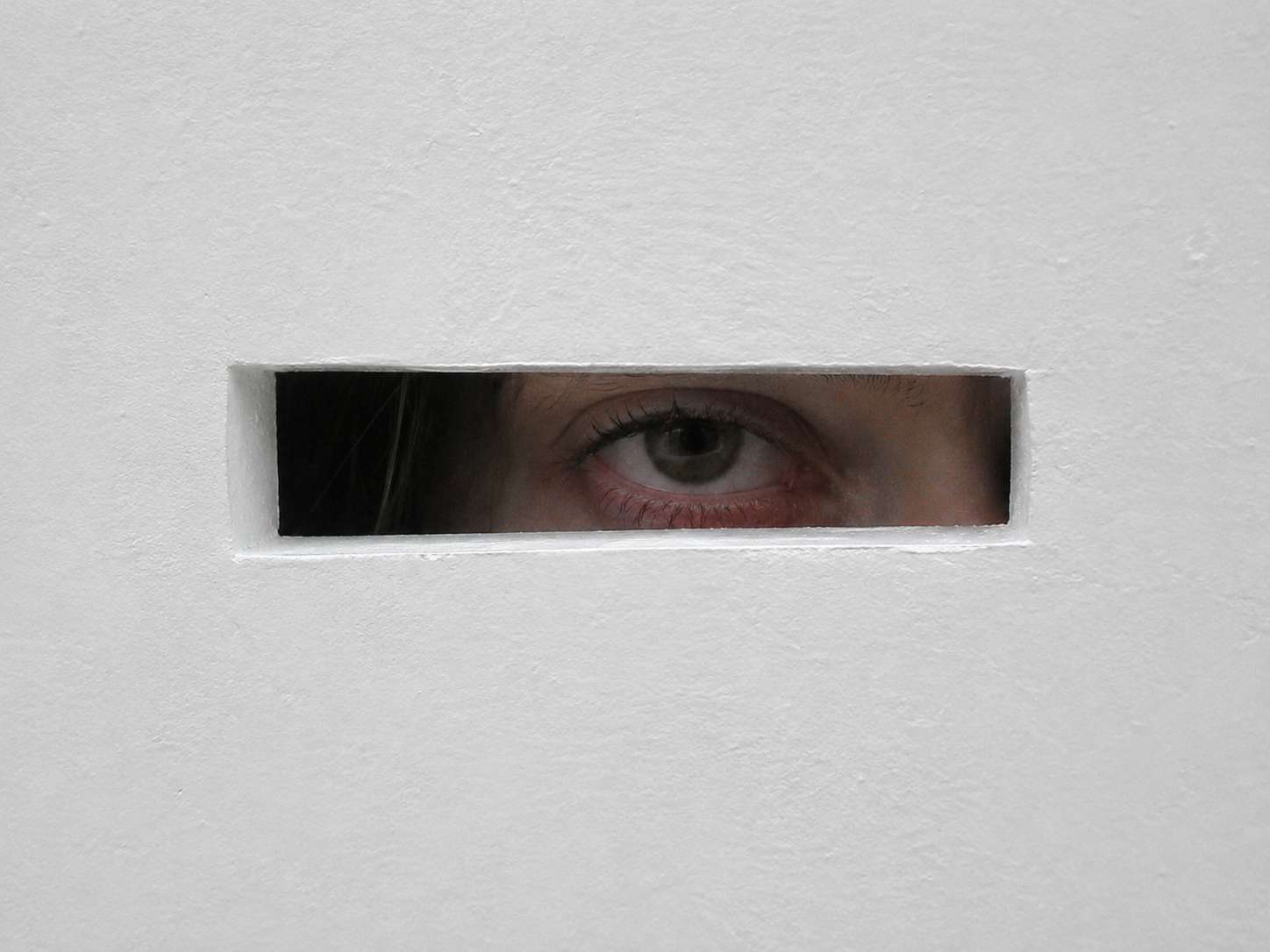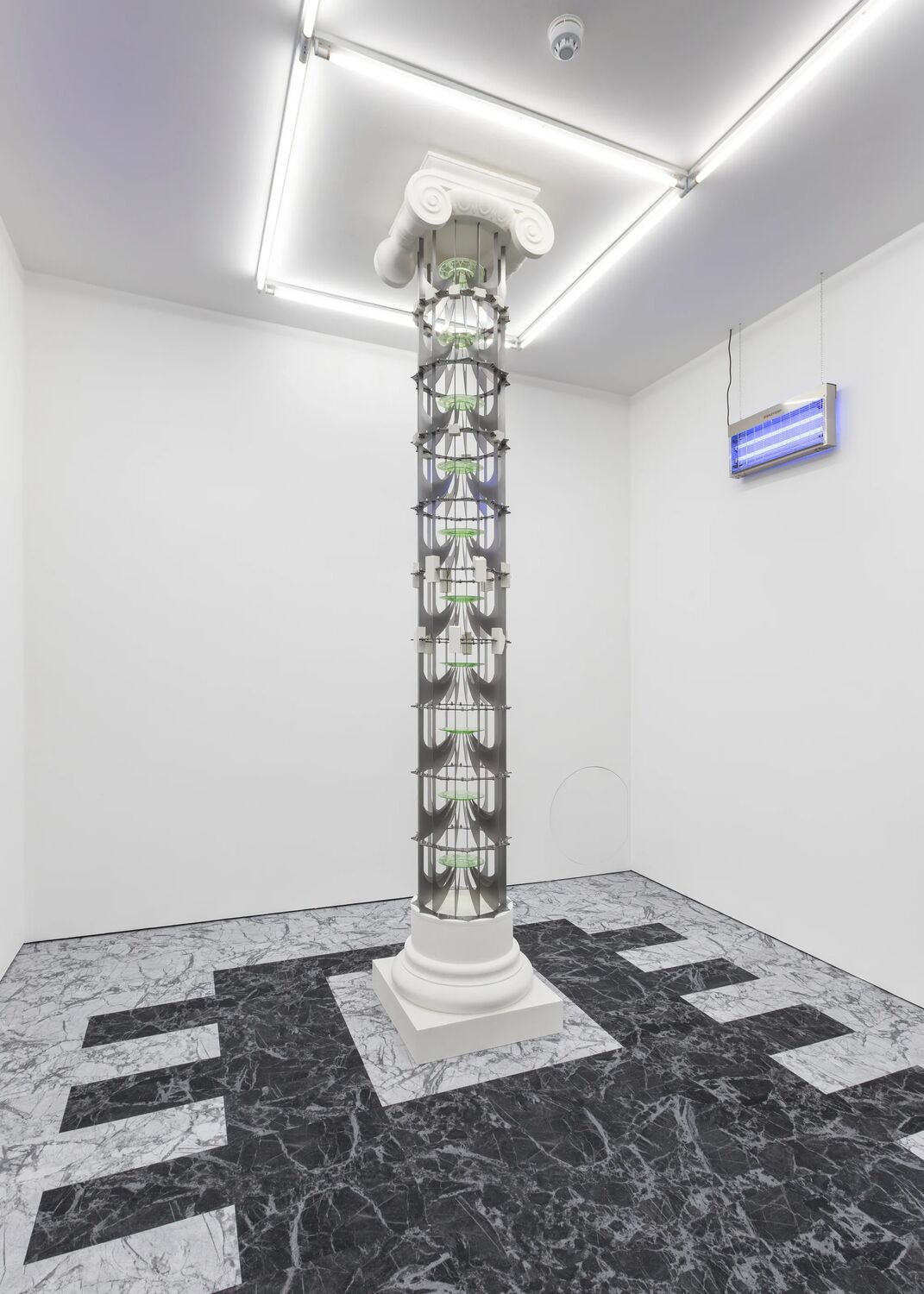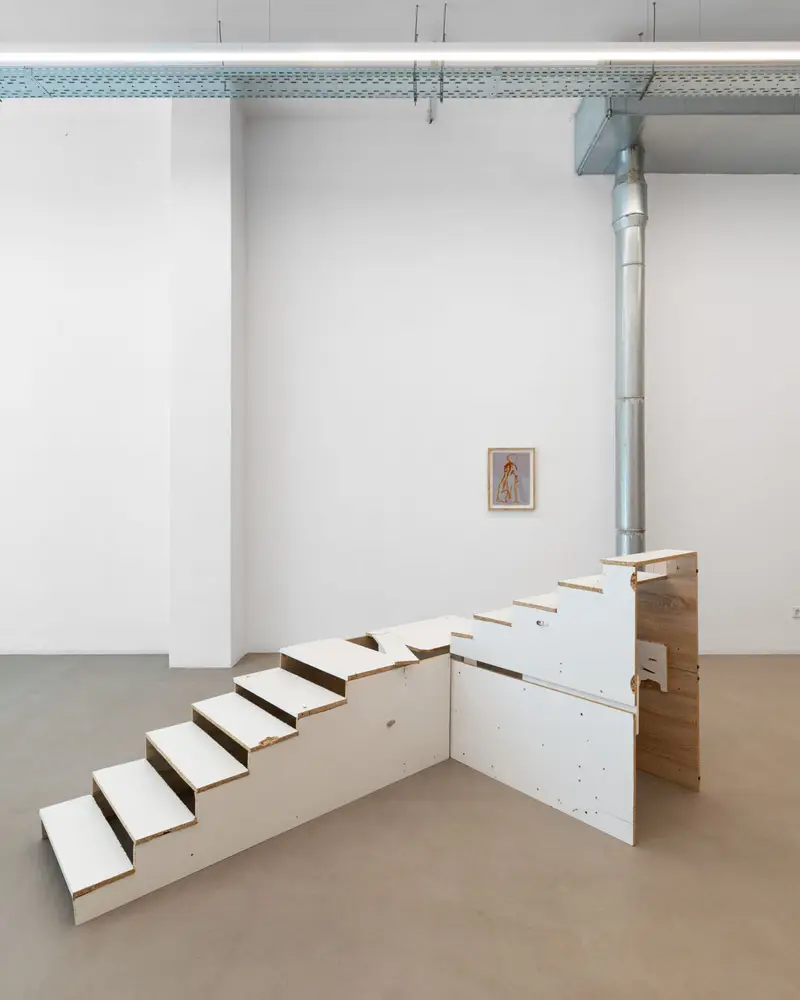
In Richard Tuttle’s 44th Wire Piece (1972), a length of wire fails to stay against a pencil line. The graphite runs directly across the gallery wall; the wire follows it, then lifts away. Under the lights, the separation produces a shadow. What might initially resemble a badly secured drawing becomes three competing accounts of one line: a mark on a surface, a material resisting that surface, and an optical effect whose position belongs partly to the room. Straightening the wire would not improve the work. It would eliminate a relation the work exists to expose.
MOCA Los Angeles lists the materials as florist wire, nails and graphite. Its account of installation describes Tuttle following the wall’s irregularities with his pencil, then pressing wire against the drawing; the wire’s resistance and the gallery lighting produce the departures. These details establish a procedure. They do not establish that every visible deviation expresses a feeling, nor that informality records a moment of spontaneous invention. My contention is more specific: deliberate imperfection becomes critically useful when it changes what viewers count as competence. It loses that force when a rough surface simply certifies an artist’s supposed authenticity.
That distinction makes “deliberate” a difficult word. An artist can choose a procedure without determining every feature of its outcome. Tuttle selects a pliable but resistant material and gives it points of attachment; he does not need to design each bend as an expressive signature. Intention operates through the conditions under which a result can depart from a drawing. Calling this bad execution assumes that the pencil line is a specification the wire should obey. Yet their disagreement is precisely what allows the viewer to recognise the wall as an active support rather than a neutral background.
Move closer in imagination to this construction and the usual scale of evaluation becomes unreliable. A wall drawing need not occupy much space to reorganise the wall around it. The narrow distance between graphite and wire asks for attention ordinarily reserved for finish: alignment, attachment, contact. Here that scrutiny discovers relationships instead of defects. A slight projection introduces depth; the shadow makes illumination visible; an uneven wall interrupts the idea of a perfect plane. The work’s apparent insufficiency increases the number of things the spectator must distinguish.
The decisive refusal concerns the standard of completion. Tuttle stops before mark, object and shadow resolve into a single authoritative contour. Their coexistence demands a different accuracy from the artist and a different patience from the viewer. Accuracy means sustaining a legible difference between elements. Patience means allowing that difference to matter before deciding that the object contains too little work. A sparse arrangement can require exact judgement even when it supplies almost none of the conventional signs of technical achievement.
This is why amateurism cannot be read directly from appearance. The amateur may lack training, work outside professional institutions, or pursue an activity without payment; those conditions have no necessary visual resemblance. A professional artist can imitate hesitation, while someone without credentials can make an immaculate object. To describe a work as amateurish is already to place it against a standard, often without identifying who established that standard or what it rewards. In Tuttle’s case, the term risks converting an inquiry into material behaviour into a verdict about the maker’s capacity.
David Pye’s The Nature and Art of Workmanship, first published in 1968, offers a useful distinction here. Pye separates workmanship in which the outcome remains dependent on judgement during making from processes that secure the result in advance. His terms, workmanship of risk and workmanship of certainty, concern the organisation of production. They need not become moral labels for handmade goodness and mechanical badness. Applied to Tuttle, they help separate accepting variation from abandoning care. The artist can cultivate uncertainty while remaining responsible for the conditions that make its effects intelligible.
Pye’s distinction also prevents us from treating every accident as an event of artistic liberation. Some accidents merely obscure a relation; some variations are so familiar that they become predictable decoration. The relevant question is what a deviation permits us to see that a smoother execution would suppress. In the wire piece, perfect coincidence would erase the interval between a drawn instruction and a material response. The departure has consequences for the viewer’s understanding of drawing. That consequence supplies a more demanding criterion than the general claim that mistakes make art human.
There is, however, an institutional complication. MOCA’s collection record specifies that Tuttle alone may install this particular piece and that it must be remade for each presentation. The slight construction is therefore supported by a strict attribution of authority. Its fragile appearance does not entail unrestricted participation. A visitor cannot simply improve it, reproduce it on the next wall, or appoint another installer without changing the terms under which the museum identifies the work. The document preserves a boundary that the object’s informal look might seem to dissolve.
This does not expose the work as a fraud. It reveals two kinds of control operating at different scales. Local control is loosened so that wire, wall and light can differ; institutional control remains concentrated around who may set that difference in motion. The spectator encounters a modest material event backed by a strong authorial protocol. Taking both seriously complicates the attractive story that technical refusal automatically weakens artistic hierarchy. Sometimes the visible relaxation of finish requires an unusually firm framework of ownership and recognition.
The wire piece thus supplies neither a recipe for making things badly nor a defence of a cultivated lack of skill. It shows that finish can be redirected. The question passes from whether a contour has been mastered to whether its several material states remain distinguishable. But the authority permitting that redirection still belongs to a recognised artist. To test the claim beyond this protected encounter, we need an object in which informal workmanship comes from other hands, and where the movement into art changes who receives credit for it.
Mike Kelley’s More Love Hours Than Can Ever Be Repaid and The Wages of Sin (1987) replaces Tuttle’s near-empty wall with accumulation. Handmade stuffed animals and knitted or crocheted blankets crowd a canvas; a separate construction gathers wax candles on a wood and metal base. The Mike Kelley Foundation’s inventory records the two parts, including dried corn in the wall assemblage. Whitney Museum documentation identifies thrift stores and yard sales as sources for the used craft objects. The disorder belongs to a deliberate composition, but the workmanship incorporated into it preceded Kelley’s authorship.
The distinction matters at the level of the surface. Bodies made to be held are packed together so that limbs, heads and patches of textile become competing units of colour and relief. A toy is still recognisable, but it cannot be approached through the ordinary intimacy of play. Its neighbours interrupt that relation. At a distance, repetition produces a field; closer inspection breaks the field into particular objects. The viewer alternates between attending to a composition and noticing that the composition is made from things whose earlier purposes it cannot completely absorb.
The work is often understood through its dialogue with the expansive surface of abstract painting. Whitney’s interpretation explicitly connects the composition to Pollock. That reference changes the status of the crowded field: what might be dismissed as clutter begins to occupy the space of an ambitious pictorial claim. Yet the individual toys obstruct the smoothness of this promotion. Their recognisable forms keep interrupting abstraction. An all-over composition becomes a means of displaying the difficulty of making different kinds of labour equivalent.
The title adds another measure. Hours of making become “love hours,” suggesting that labour offered as a gift may create an obligation no recipient can adequately discharge. This is an interpretation encouraged by the title and by Kelley’s recorded discussion of the work at the Whitney. It is not evidence about any particular maker or recipient. We cannot infer from a secondhand toy that its original owner rejected a relative, or that the person who stitched it intended to impose guilt. The sculpture stages those possible relations without recovering the biographies that would confirm them.
Its roughness is therefore distributed across incompatible positions. The original maker may have pursued the neatest possible seam. Kelley may have selected the object for a mixture of formal and cultural reasons. The viewer may call that seam amateurish because it appears beside objects with different proportions or levels of finish. A judgement that sounds like a description of technique can actually register the collision of several systems of value. Nothing about the toy’s unevenness tells us, by itself, whose refusal it embodies.
This is a harder case than the expert artist choosing an unstable material. Kelley does not simply relax his own standards of manufacture. He relocates other people’s making into a structure bearing his name. That relocation can expose a hierarchy between recognised artistic composition and domestic craft. It also benefits from the hierarchy: the named artist’s act of selection becomes legible as an intellectual operation, while the unnamed makers remain represented through their products. Critical recognition and unequal attribution arrive in the same gesture.
The difference is visible even without identifying the makers. A knitter’s repeated stitches record competence through consistency, while the assemblage derives force from heterogeneous objects interrupting one another. What counts as quality in the component need not count as quality in the whole. Kelley’s arrangement converts differences of finish into rhythm and density. The conversion explains why praising the work as gloriously inept would miss its precision. It would also repeat the dismissal of craft on which the art-versus-amateur opposition depends.
The candle construction complicates the transaction further. Wax records change through softened edges, drips and accumulations: forms produced by use as well as fabrication. On its base, it suggests an improvised monument whose excess carries a different temporality from stitching. The companion titles bring work, repayment and wrongdoing into proximity. The installation allows the reader of those titles to move between affection and accounting, attachment and expense. Its materials do not resolve the movement into a stable moral lesson.
Kelley’s work thus makes the familiar celebration of imperfection ethically insufficient. To call an irregular object warm or authentic can turn anonymous labour into atmosphere. The sentiment seems generous but may leave the conditions of recognition untouched. In this assemblage, the irritation of surplus prevents easy reassurance: there is too much to cherish as a single intimate gift, and too much specificity to treat the field as anonymous texture. The encounter makes viewers participate in the alternation between those readings.
Its later circulation adds a second conversion. A frontal photograph can compress protruding toys and textiles into a busy rectangle, strengthening the resemblance to painting while reducing the physical awkwardness of their accumulation. A caption then restores distinctions that the image flattens: handmade objects, found materials, canvas, candles, two parts. The documentation does not simply transmit a stable roughness. It changes which properties of the work carry the argument. The scale of a screen and the completeness of the framing can make excess look composed and manageable.
This is also how an aesthetic of refusal can become a professional convention. Once uneven edges, found textiles or provisional arrangements signal a recognised attitude, their repetition may reassure an audience that knows the code. Recognition alone is not disqualifying; no artwork escapes learned conventions. The sharper question is whether a work still forces a consequential revision of judgement. Kelley’s assemblage does so when it makes admiration for the artist’s intelligence inseparable from the uneven recognition of the people whose making he has gathered.
The resulting criterion cannot be reduced to sincerity. We have little direct access to an artist’s internal authenticity, and less to that of unidentified makers. We can instead examine the operation: what has been selected, how it is joined, what associations the title activates, and whose labour becomes visible or disappears. The object’s informal appearance begins an inquiry into value without guaranteeing its conclusion. A counterexample now becomes necessary: a work that refuses the hierarchy of technical mastery while presenting a surface manufactured with considerable regularity.
Rosemarie Trockel’s Untitled (1987), in MoMA’s collection, stretches machine-knitted wool across a frame. The phrase “Made in Western Germany” repeats through the textile. MoMA records its dimensions as 250 by 180 centimetres and explains that a commercial machine was programmed to produce the wording. The work occupies the frontal position of a painting while replacing its familiar support with a material associated with clothing and domestic craft. The manufacturing phrase, normally subordinate information attached to a commodity, becomes the organised substance of the picture.
This surface offers a necessary objection to any equation between technical refusal and deliberate imperfection. Trockel does not need a dropped stitch to challenge the hierarchy between painting and knitting. Machine production removes the expected evidence of patient individual handwork while retaining the cultural associations of wool. A viewer expecting expressive brushwork encounters repeated language; a viewer expecting a handmade textile encounters industrial procedure. Regularity is the means by which those expectations are brought into conflict.
The work is best read through the incompatible scales of its information. At the scale of the stitch, wool forms an organised fabric. At the scale of the phrase, the picture announces a place of manufacture. At the scale of the framed rectangle, it enters a convention of public aesthetic attention. These levels occupy one surface without becoming interchangeable. The phrase can be read as information, but repetition makes it pattern; the textile can be seen as pattern, but its frontal presentation asks for sustained reading.
MoMA’s label situates Trockel’s knitting pictures within a critique of a male-dominated art world and the subordinate place assigned to craft. That institutional interpretation is a useful starting point, not a substitute for describing the procedure. The force of this particular work lies in how it complicates the opposition it invokes. Traditionally feminised material is processed by a commercial machine and presented through the apparatus of painting. Neither artisanal intimacy nor industrial impersonality can claim the surface without qualification.
Technical refusal can therefore take the form of refusing to perform the kind of skill an audience expects to see. Trockel displaces visible evidence of an individual hand while insisting that wool sustain the ambition of a large picture. The work challenges a judgement organised around medium and gender without asking irregularity to prove the challenge. It exposes the limitation of imperfection as a critical category: some of the most effective refusals leave a remarkably consistent surface.
The phrase makes that consistency more pointed. “Made in Western Germany” identifies a national and commercial framework rather than the singular source promised by an expressive mark. Because the work dates from 1987, the geographical designation belongs to a divided Germany; it is historical language as well as a manufacturing formula. We need not invent an encoded political message to recognise that the words place production within systems larger than an artist’s body. The surface gives origin the repeatability of a pattern.
This returns us to authorship by another route. In Tuttle, the artist’s presence is protected through installation conditions. In Kelley, different makers’ labour enters a named artist’s composition. In Trockel, programmed manufacture produces a work whose authorship remains singular despite the absence of an individually fashioned stitch. Together these cases show that virtuosity, manual effort and artistic attribution are related through arrangements rather than natural correspondences. The visible hand is one possible sign of authorship, never its sufficient explanation.
A viewer consequently needs more than a preference for roughness to distinguish an inquiry from a manner. One practical test is to ask what would change if the work were made more conventionally accomplished. Align Tuttle’s wire perfectly with graphite and a spatial disagreement disappears. Replace Kelley’s disparate objects with uniformly fabricated toys and differences of labour and use become harder to register. Add expressive irregularities to Trockel’s knitting and the work might drift toward the reassuring signature of handwork that its industrial procedure unsettles.
These imagined alterations are critical instruments, not proposals for correcting the works. Each identifies a property that carries a consequence. They also show why no shared appearance can guarantee a shared politics. A loose attachment can expose a material relation or merely simulate informality. A machine can enforce sameness or disturb the prestige of manual expression. An assembled object can dignify overlooked labour while redistributing its credit unfairly. Evaluation begins when those possibilities are described at the scale of a particular procedure.
The contemporary appetite for visible process makes this attention especially necessary. Photographs of seams, drips and workshop debris can supply instant evidence that an object has passed through a human situation. Such evidence may be accurate and still function as a familiar sales language. A trace becomes decorative when its meaning arrives before any examination of how it was produced. Conversely, an apparently finished surface may conceal a complex redistribution of tasks whose consequences become clear only through documentation.
Documentation should therefore be used to test the eye without overruling it. A museum’s materials list can distinguish found handicraft from newly manufactured imitation; an installation protocol can identify what may vary; a production account can establish the role of a machine. These facts limit speculation. Interpretation then connects the verified procedure to what the work makes perceptible. It should neither manufacture a story of struggle from a damaged edge nor accept an artist’s stated refusal as the final account of its effect.
The value of deliberate imperfection lies, when it has value, in that connection. A departure from a standard must make the standard available for thought and alter our encounter with what has been made. It can shift attention toward overlooked labour, expose the conditions of display, or redirect competence toward maintaining a productive difference. It can also settle into a recognisable finish of its own. Returning to Tuttle’s lifted wire, we can now see why its bend matters: it makes an interval available to perception. The critical question begins with what occupies that interval, and continues with who gets to define it.