In Carolee Schneemann’s Fuses, there are moments when the image has so many marks on it that it takes time to see what the camera recorded. A hand, a stretch of skin or part of the room can emerge through colour on the film. Schneemann made the work between 1964 and 1967, filming herself and her partner, the composer James Tenney, having sex. She also painted, burned and collaged the 16mm material. What the two people did together and what the filmmaker did to the strip of film enter the image at different times. A viewer who wants to see the first has to look through the second. That fact gives the work a way to interrupt the assumption that, once an act is made visible, the person looking has been given straightforward access to it.
The description of a work as sexually extreme can do a great deal of work before anyone sees it. It can suggest how much will be shown, what kinds of behaviour might be depicted, how unwilling a viewer will be to encounter them, or how far an artist will go in involving other people. These are different judgements. The same image might be ordinary within the life of the people who made it and alarming once it enters a museum or a courtroom. A performance may show very little and still ask more of the people present than a photograph does. A useful account of the extreme begins with the particular limit a work approaches and with who has the power to decide where that limit is.
Sex includes acts that can be performed, felt or remembered without becoming available to anyone else. Sexuality is also a way people are asked to account for themselves through identities, habits and desires. The two come together when someone is told that an act, an image or an object is evidence of the kind of person they are. In the first volume of The History of Sexuality (1976), Michel Foucault questioned an account that would reduce modern power over sex to the keeping of a silence. The institutions that sought to regulate sexuality also gave people powerful reasons to speak about it. They created settings in which some accounts became evidence to be interpreted. In an exhibition, the invitation to look can raise a similar question. What sort of knowledge is the viewer expecting the explicit image to hand over?
The works considered here ask what it costs to make sexual life available to someone else’s attention. On film the cost may be a loss of control over who sees an intimate event. In a performance it may be the visitor’s inability to tell when they have become part of what is happening. In an institution it may be that a body, an act or a relationship has to be recognised in someone else’s terms before it can appear in public. An artwork can bring any of those costs into view. It can also produce one of them in the course of doing so.
Schneemann’s handling of film makes it difficult to assign her a single position in relation to the image. She appears in front of the camera, and the image bears the consequences of decisions she made as a filmmaker. One could try to isolate the sexual action as the subject and take the scratches or overlaid colour for style. A few seconds spent watching make the division hard to maintain. The condition of the film determines which parts of a gesture are available and how long it takes for them to become recognisable. It gives the viewer time to register that someone who took part in the event could have returned to its image and changed the conditions under which anyone else would see it.
A still from the film can preserve the presence of a painted mark. It gives little sense of how long a viewer might wait for a recognisable figure to emerge, or how quickly that figure may be obscured again. This is one reason the work changes when it is introduced by an image that makes its explicitness plain. The still can settle a question about what the film contains while concealing the difficulty of seeing it. In the film, to know what an image contains has very little to do with having seen all there is to see. Fragments of a room can matter as much as whether a body can be identified. What becomes visible at one moment cannot be made to supply a whole account of the relation that produced it.
The separation between an encounter and its public image becomes sharper in VALIE EXPORT’s Action Pants: Genital Panic (1969). In the photograph by Peter Hassmann, EXPORT sits facing the camera in trousers cut open at the crotch. She holds a gun. The image is often taken as the record of an action in a Munich cinema, although the photograph was staged separately and the cinema story should be understood as a reported action. The distinction matters. A person encountering the picture is placed in front of an artist who is already facing them. That position is made for the camera and can be reproduced wherever the photograph circulates. The picture does much of its work long after anyone might have been present at the action it invokes.
A cinema usually lets a spectator see people who cannot see them. The room is dark. People beside one another can attend to the same image without much conversation about why they are there. The reported action put an exposed body within that shared space. Hassmann’s photograph makes another change. The exposure is present, and so is the steady gaze of somebody who appears to know exactly where the viewer will be. The image does not tell us how to feel about that gaze. It makes the privilege of looking without being noticed difficult to imagine. In Fuses, the surface of the film repeatedly interferes with access to the recorded event. Looking at EXPORT, the viewer can see plenty and still encounter the question of what entitles them to the position from which they do so.
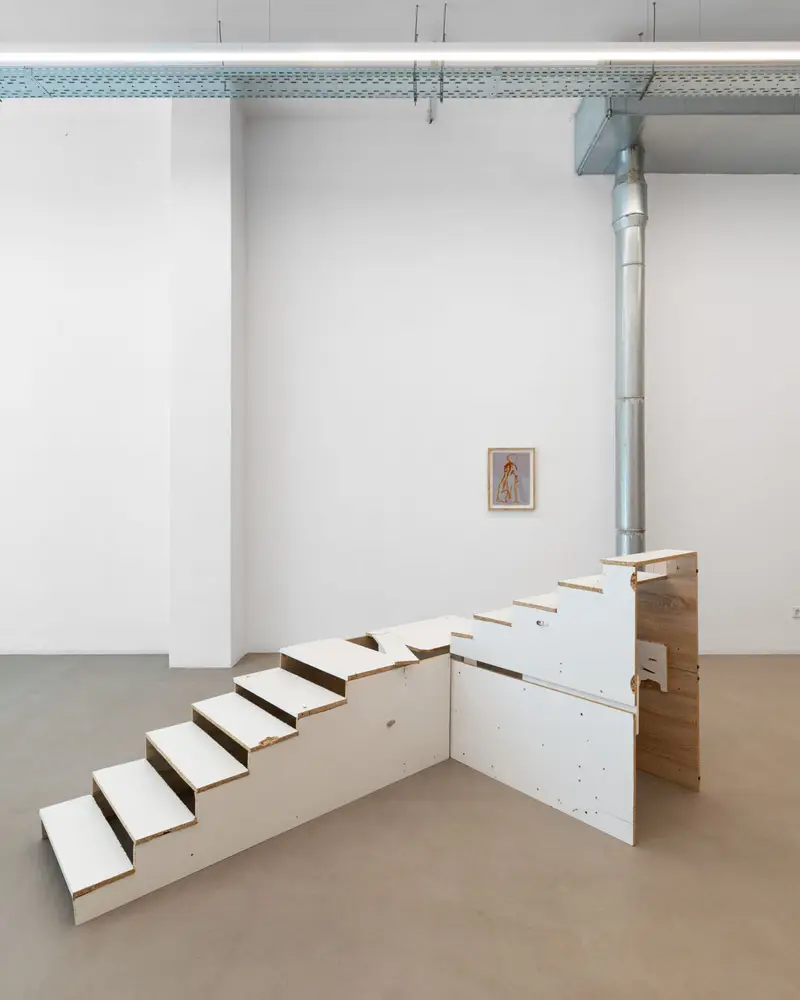
When visitors entered the Sonnabend Gallery for Vito Acconci’s Seedbed in January 1972, they found a low wooden ramp. Acconci was underneath it, out of sight. He masturbated and spoke fantasies prompted by the movements of visitors overhead. His voice reached them through speakers. A room that normally allowed people to come in, walk around and take their bearings had given those movements another use. A step could enter the work before the person taking it understood what the artist was doing. The ramp established a relation between bodies while allowing the artist and the visitors to remain invisible to one another. It is difficult to separate what the work made possible from who got to know about it first.
The frequent description of the work as an exchange between artist and audience can make that relation sound more even than it was. The visitor had the freedom to enter, move and leave. The artist could turn a visitor’s presence into material for a sexual address and decide what to say about it. These were quite different freedoms. Someone hearing the voice might choose to keep walking or decide to remain in the room. Their choice came after the walk had already acquired a significance it would never have had on the ordinary floor of the gallery. The structure is interesting in part because a person could register its asymmetry without seeing an explicit image. The work had made the floor and the sound system do much of what a sexual picture is usually expected to do.
The surviving documentation puts a later viewer in a position different from the one the work supplied in 1972. A museum can show a recording with the title and date available in advance. A person who comes across it knows it is a work by Acconci and may already know what took place under the ramp. This can give them time to think about the original encounter. It may also make it harder to imagine how it would have felt to learn about the work in the room, after having done something that counted as taking part. The distinction is important when institutions exhibit performances retrospectively. They can preserve evidence of an encounter more readily than they can give a viewer the relation to knowledge that once made it difficult.
Entering a gallery is a decision to enter a gallery. The meaning of that decision changes when an artist lets an ordinary act of attendance count as participation. Discomfort is neither proof of harm nor a guarantee of critical force. It can tell us that somebody has discovered a condition of the encounter after it began. The question the work leaves for the institution is whether a visitor can understand enough about the terms of participation to have a meaningful say in them. Knowing that a gallery shows experimental art supplies very little information about any particular encounter there.
Andrea Fraser’s Untitled (2003) begins with an arrangement whose terms are negotiated in advance. A dealer helped find a collector who would take part in a sexual encounter with Fraser in a hotel room and buy a copy of the resulting video. A fixed camera recorded the encounter. The video was issued in an edition of five, and the public work is silent. The Whitney Museum’s copy was acquired from the participating collector through a combination of gift and purchase. A description can give all these facts and leave one very simple question open. What exactly could the collector secure by agreeing to buy a copy before the camera was turned on?
The existence of the edition makes the question more precise. The participant’s copy could be held, sold or given away. The encounter could never pass from hand to hand in the same manner. When the museum acquired its copy, it acquired an object whose passage into the collection involved a person who had helped bring the work into existence and remained unnamed to the public. That sequence is part of what the work makes available for thought. In another sale, the buyer might remain just as private without the purchase ever appearing to be relevant to what the image means. Fraser gives the relationship between the person paying and the conditions of production a place in the account of what a visitor sees.
The camera records what happened within its field and for the time it was running. It cannot record the negotiation of which the encounter is one consequence. Seeing the two people together does little to establish who could set the terms or what each had at stake in agreeing to them. The information supplied by the gallery or museum therefore has unusual weight. It makes visible some of the relations the camera cannot disclose. It also puts the institution in a position to name those relations for the audience. A viewer who is suspicious of the market can still be grateful to the label for explaining that there was a market transaction to think about. The work gives them a reason to examine how much confidence they put in that explanation.
The relation between these two works is clearer if we ask when the terms of looking become known. In Seedbed, the artist was present beneath the floor, and a visitor might learn the terms while they were already being applied. In Untitled, the immediate participants knew a great deal in advance, while the viewer inherits evidence of a private agreement that has since become public in a different form. The later viewer cannot change the agreement. There is room, however, to ask who was able to take a position in it. The museum has physical custody of the copy and can decide when to show it. An account of the work has to make room for that decision too.
Robert Mapplethorpe’s X Portfolio, published in 1978, brings a different kind of public into the problem. The portfolio consists of black-and-white photographs concerned with gay male sadomasochistic sexuality. The prints are carefully composed and were issued as an edition. Somebody can talk about the pictures by referring to lighting, the placement of bodies and the distribution of tones across the sheet. Those were among the features that made a discussion of the pictures possible within a history of photography. They also gave viewers terms in which to defend them. There is a difficulty in that defence. It can make it sound as if the people in the photographs and what they are doing need the distinction of an accomplished print before there is a reason to take them seriously.
The Perfect Moment, the retrospective curated by Janet Kardon, opened in Philadelphia in 1988 and travelled to the Contemporary Arts Center in Cincinnati in 1990. The centre and its director, Dennis Barrie, were prosecuted over photographs shown in the exhibition, among them several from the X Portfolio. Both were acquitted. The process put to a jury a question about what could legitimately be shown. The pictures were still the same size and had the same tonal range. The authority to determine the form in which they would circulate had shifted to people who could stop looking at any particular print and still have a say in whether other people should be able to see it. A museum visitor and a juror can look at the same image with fundamentally different powers.
A photographer’s ability to decide what will remain visible has its own consequences. Within a community, a practice can have familiar rules, vocabulary and ways of recognising a partner’s intentions. Very little of that needs to be legible in a single photograph. A viewer outside that community can be surprised by the picture and assume that the surprise is evidence of something about the lives of the people in it. It may be better evidence of which lives the viewer had previously expected to find represented in public. The demand for a print to prove its aesthetic distinction before it can appear in a museum can make a similar error. It asks a particular image to settle a judgement about the kinds of people and practices to which an institution is willing to give its space.
There is something worth defending in the possibility that an image can move across those settings and acquire a public its subjects could never have assembled in one room. Circulation also gives more people opportunities to decide what the image will count as evidence of. A museum can give somebody time with a picture that was formerly kept out of view. It can in the same act secure its own position as the place in which the picture has to be made respectable. Much depends on whether the institution can make the conditions of display intelligible while allowing the people and practices represented to exceed the account it gives of them.
Shu Lea Cheang’s Brandon (1998–99) brings that question into the way a work is accessed. The Guggenheim commissioned the project for the web. Its point of departure was the life and murder of Brandon Teena, a trans man killed in Nebraska in 1993. The project does not follow a single route through his life. It gives the visitor several interfaces, among them a road trip and a panopticon. Their relation to one another makes navigation part of what a visitor has to think about. A road implies movement between places and allows people to pass out of view. A panopticon makes visibility a condition of confinement. The two invite very different understandings of what someone might want to know about a person and how they could acquire that knowledge.
Gender identity and sexual practice describe different aspects of a life. The conditions under which Brandon Teena was made publicly legible matter here because a person’s gender can be subjected to demands for proof that borrow a great deal from the policing of sexuality. A web interface can make the demand seem ordinary. It offers something to click and gives the person who clicks a reason to expect more information. Cheang can work with that expectation because the encounter is distributed across several screens and kinds of material. A visitor can become aware, in the course of following a route, of a desire to arrive at an account that would tell them everything they thought they needed to know. That desire belongs to the act of viewing. It is available for examination even when the work declines to satisfy it.
The Guggenheim later restored the work as parts of the original site stopped functioning. In a film, a conservator can try to keep a splice or a mark on the stock visible. With Brandon, some of what has to be preserved is the possibility of moving from one thing to another. An inactive link can leave two pages physically available and remove the relation that once made a visitor discover the second through the first. The detail brings us back to Acconci’s ramp, Fraser’s edition and the surface of Schneemann’s film. The materials exert their force partly by setting up a particular order in which someone can come to know what they are looking at.
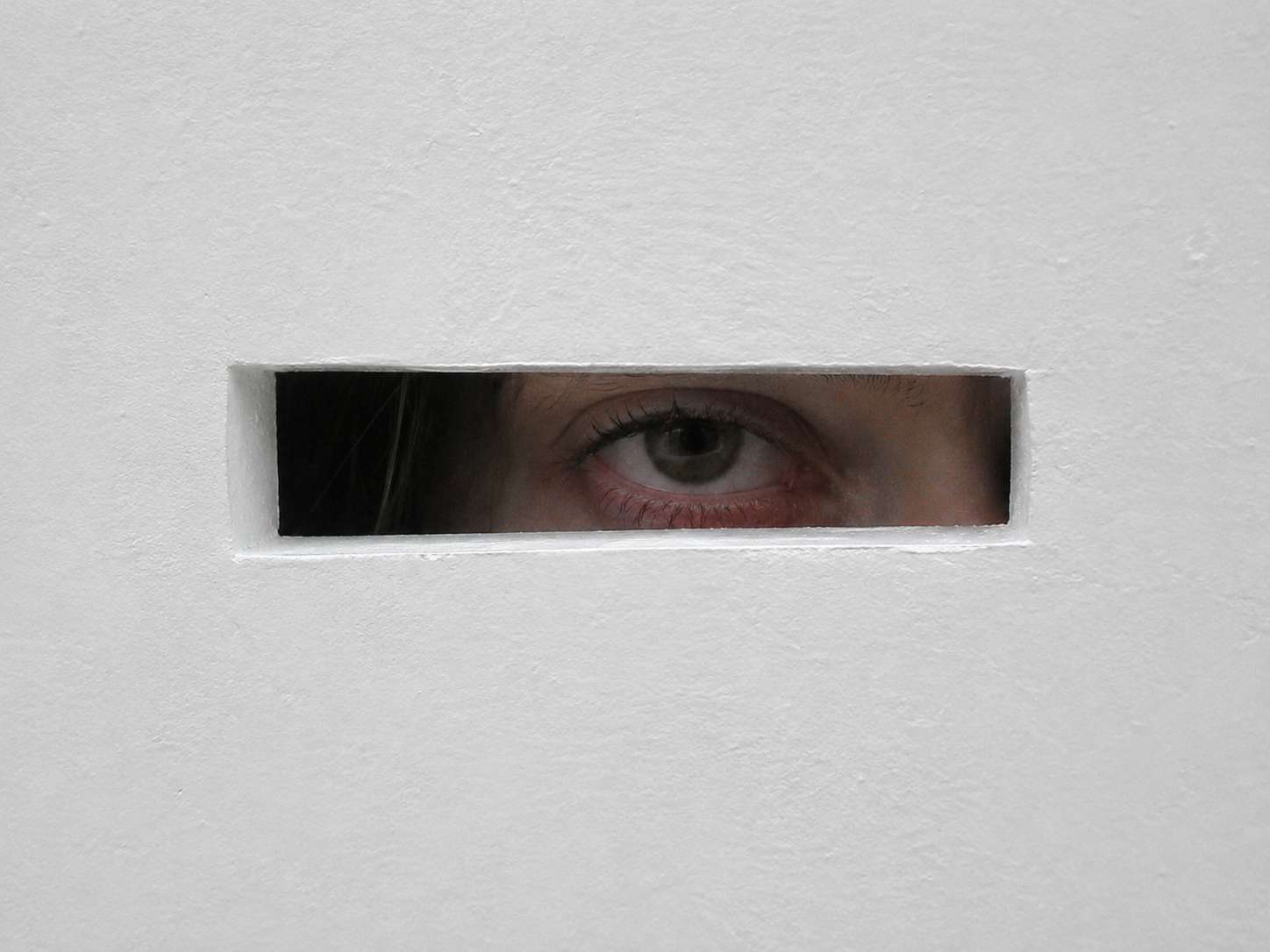
On the cover, an eye looks back at us through a narrow opening in a white wall. It cannot tell a reader which of these works they would find difficult to spend time with or what kind of attention their difficulty might require. The different works make that question more answerable in concrete terms. A film can disclose the maker’s right to return to her own image. A voice coming through a floor can make the terms of participation difficult to establish. An edition can give money an intelligible place in the history of an intimate event. Where a work makes a demand on the viewer, there is still a decision to make about whether to stop, move closer or ask what has already been decided on their behalf.