A piece of cardboard can spend part of its life on a pavement in Dakar and another part in an exhibition. The Biennale de Dakar’s account of Pape Diop describes a practice spread across walls, sidewalks and found supports in the Médina. Some of those supports can be moved indoors. A wall and the view of it from across a street are harder to carry. Diop’s recurring portraits include figures associated with Senegalese religious life, among them Cheikh Ahmadou Bamba. In the street, the face may meet someone who recognizes it before they have a name for the person who drew it. In the exhibition, the artist’s name is likely to be the first thing the visitor is given. The same marks can begin two very different encounters.
That change is worth attending to now. Dakar’s sixteenth biennial is scheduled to run from November 19 to December 19, 2026, under Morad Montazami’s artistic direction, with Diop in the official international exhibition. The title, (Anti)fragilité, gives a particular resonance to objects made on supports that can bend, soak up water or disappear when a street is cleared. Yet Diop’s presence also poses a practical question for the exhibition. How much of the work belongs to the place where someone has learned to expect it? Diop has already had a history of being exhibited within Dakar. The 2023 Constellation Médina presentation at Le Loft was part of Partcours, and the association Yataal Art has worked with and preserved his practice over years. An international biennial adds another public to a history of looking that was already being organized locally.
Diop is a name to follow because the relation between the support and its audience is still at stake each time the work is shown. A drawing on a piece of salvaged wood can enter a collection. Its availability to the person walking past it may have depended on a different arrangement altogether. A photograph that shows where it stood can recover part of that arrangement, including the height at which someone could see it and what was around it. The object in a case will offer a different kind of evidence. An exhibition can decide to give both kinds of evidence room. It can also make the movable object carry the whole story, leaving the street to appear as a short account of where the artist came from.
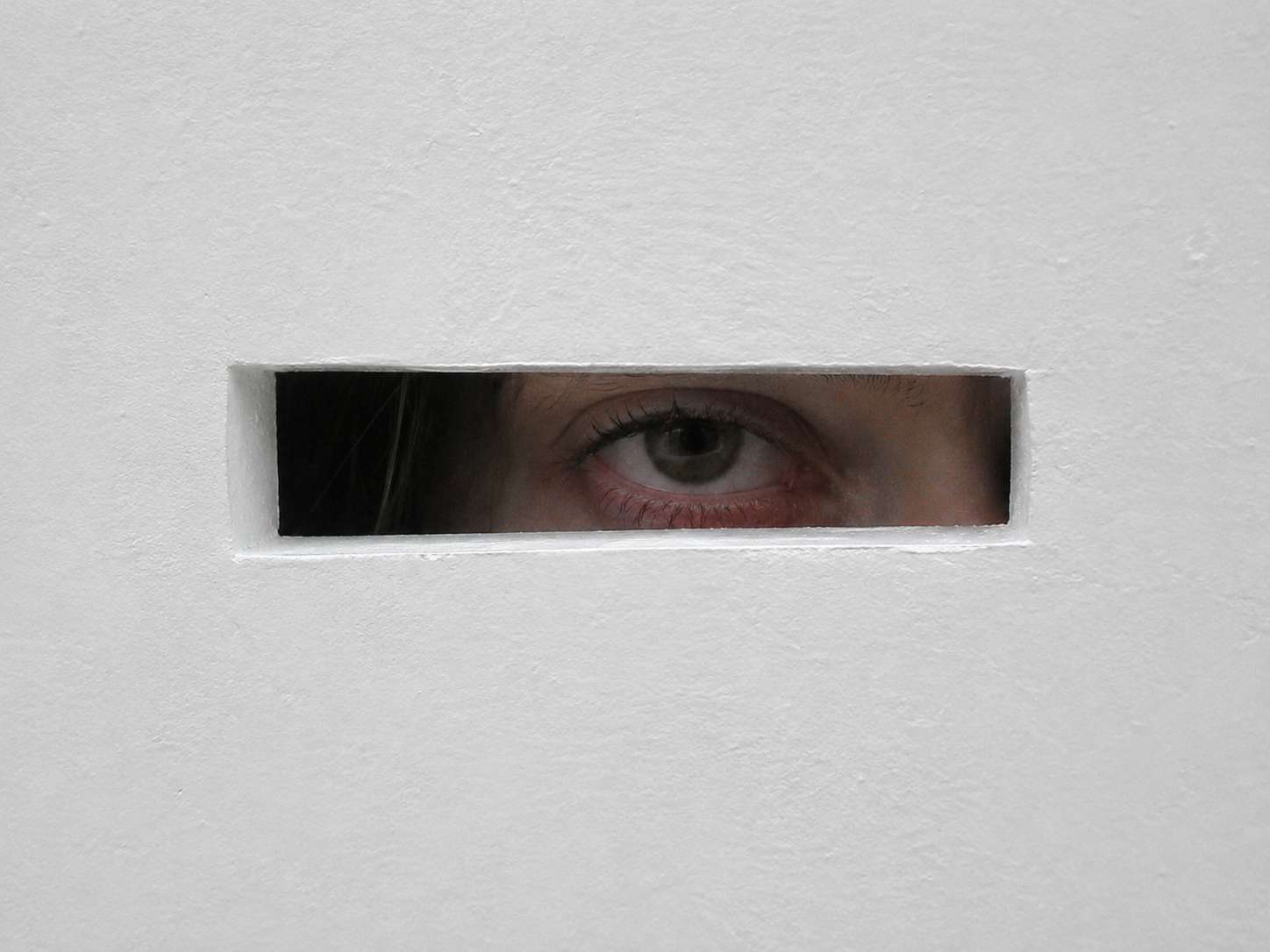
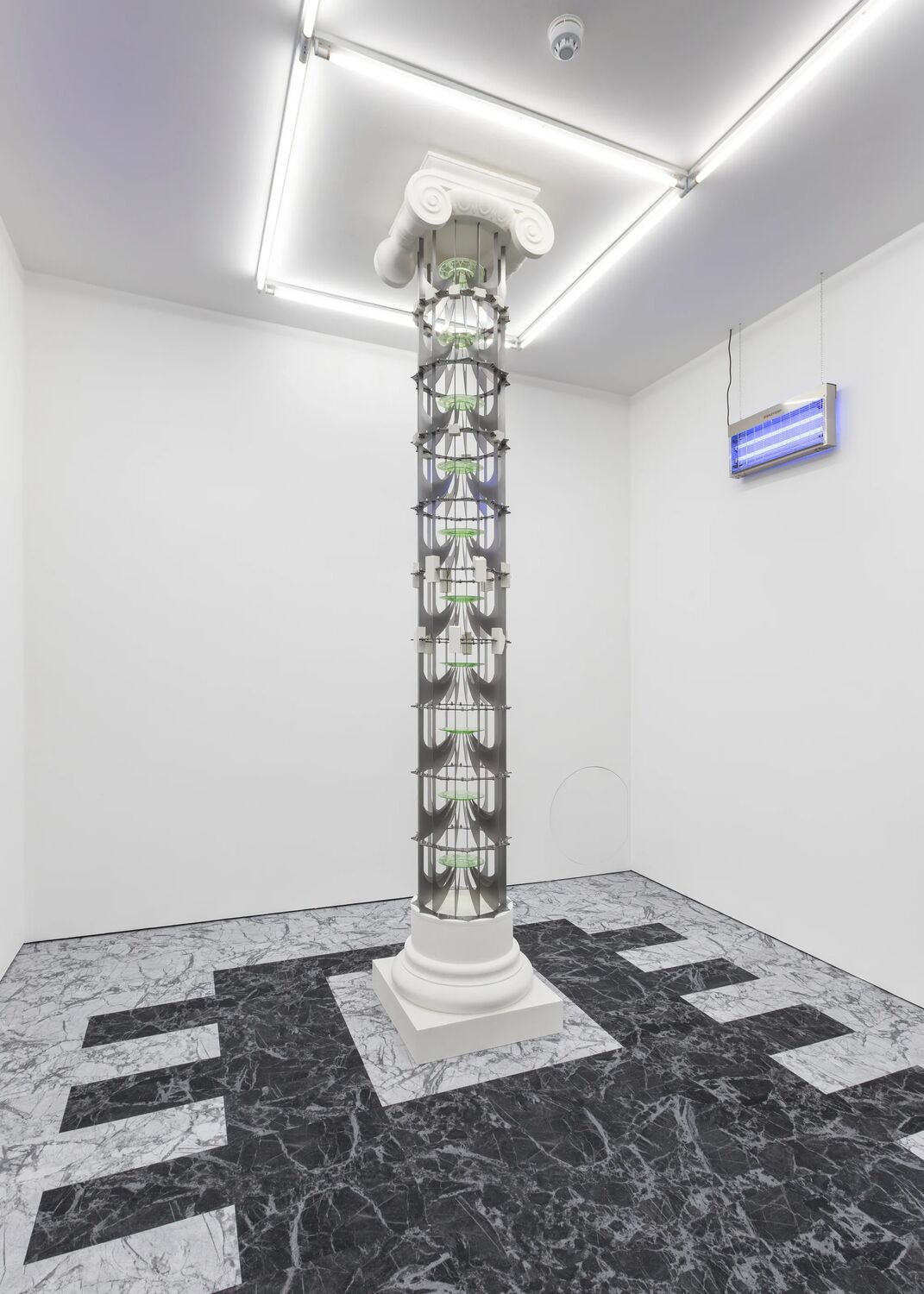
At the Venice Biennale, which closes on November 22, another Senegalese practice is operating through an almost inverse distribution of visibility. Caroline Gueye’s Wurus, curated by Massamba Mbaye for Senegal’s national pavilion, takes its title from the Wolof word for gold. Gueye trained in physics. In the pavilion she works with light, mirrors and materials that include brass, bronze and polymer. In an interview with Narthex, she describes how a form evident from one position can become difficult to distinguish from another. The palazzo supplies corners and distances through which the visitor must move. The means of seeing something valuable are built into the encounter before we decide what, in this room, deserves that description.
Gold can be discussed through space and time at radically different scales. It is a substance with a history older than the Earth, an instrument of exchange and a medium for displaying power. The pavilion’s sources also place it in the history of the Mali Empire. Gueye’s arrangement brings those registers into a room where a change of angle can alter what a surface appears to be doing. That is the point at which her practice becomes interesting beyond the occasion of national representation. A painter may use a reflection to build the image of a room. Gueye can put the relation the other way around, using a room to make a reflection available only under particular conditions. The visitor gets to test the stability of what they thought they saw.
The national pavilion offers one frame for such work. Venice’s central exhibition, In Minor Keys, gives another to the late Seyni Awa Camara. The Biennale’s catalogue traces her practice to Basse-Casamance, where she learned to work clay from her mother. The pots and utensils she made early in life belong to a history of knowledge transmitted through hands, households and markets. Over time, that knowledge became available to creatures with broad feet, striking eyes and forms that make it difficult to say where a human figure ends and another kind of body begins. The catalogue describes her working closely with family. A museum can give one of her figures an isolated plinth, which makes its contour easier to see. The figure also bears the record of a practice in which making took place among people already accustomed to living and working with clay. That history deserves as much attention as the category a new exhibition assigns it.
Put Diop, Gueye and Camara beside one another and there is little reason for their works to agree about where an encounter with art should begin. For Diop a familiar face can have a public before the support is recognized as a work. For Gueye the visitor’s movement is part of what produces the image. In Camara’s case, the material carries technical knowledge acquired long before the sculpture reaches a venue able to circulate its photograph. Each is an entry into a different part of Senegalese artistic life. The national label makes their proximity available in a programme. The differences between the practices give the proximity some use.
One way to follow this scene across the next year is to look for the people and places that carry a work between those settings. Diop’s collaborators have experience of the Médina that a catalogue cannot acquire during an installation period. The practice that formed Gueye involves movement between scientific and artistic institutions with different ideas of what a visible effect can demonstrate. Camara’s work puts a family history of making into the room with the international history of exhibition. The decisive question comes after the invitation. Which parts of the practice become easier to see, and which depend on the work remaining close to where it began? In Indonesia, several artists and collectives have made that question into a matter of what an exhibition can ask people to do together.
A roof tile has a place in the building before it has a part in a piece of music. Turn it into an instrument and the clay begins to carry information about the person striking it, the room and the distance to the next player. In Jatiwangi, a town in West Java with a history of producing clay roof tiles, the collective Jatiwangi art Factory has developed a public practice around that change of function. During Rampak Genteng, participants sound instruments made from tiles together. The programme for documenta fifteen describes the gathering as a recurring event in Jatiwangi dating back to 2012. Its entry in a festival calendar tells us when people should turn up. It takes a longer history of working with the material for the gathering to mean something in town.
Jatiwangi art Factory was founded in 2005. Its work is useful to follow because several aspects of it often get separated in an exhibition. There is a material with an industrial history. There are skills held by people who learned to work it in order to earn a living. And there is a set of occasions on which those skills can be taken up differently. You can place a tile in a museum and describe all three things. Sound it with other people and you have to settle where you can meet, who can be heard, and how to begin and stop together. Those decisions are part of the knowledge the work puts into use. The ceramic object can pass through an exhibition without exhausting the purposes for which it was made.
In Kassel in 2022 the collective participated in documenta fifteen, under the artistic direction of the Jakarta collective ruangrupa. The edition borrowed lumbung, the Indonesian word for a communal rice barn, to describe ways of pooling resources and sharing responsibility. There was already a place to see what that approach could involve. In South Jakarta, ruangrupa, Serrum and Grafis Huru Hara had formed Gudskul, a space for public learning and collective study. For a visitor, the contrast between the timetable of an international exhibition and the ordinary work of a place like Gudskul is instructive. At the former one can encounter the method at an appointed hour. At the latter the method requires a place that people can continue using after a particular event has ended. The exhibition can make the method easier to encounter. Its institutional life also depends on arrangements that rarely make good installation photographs.
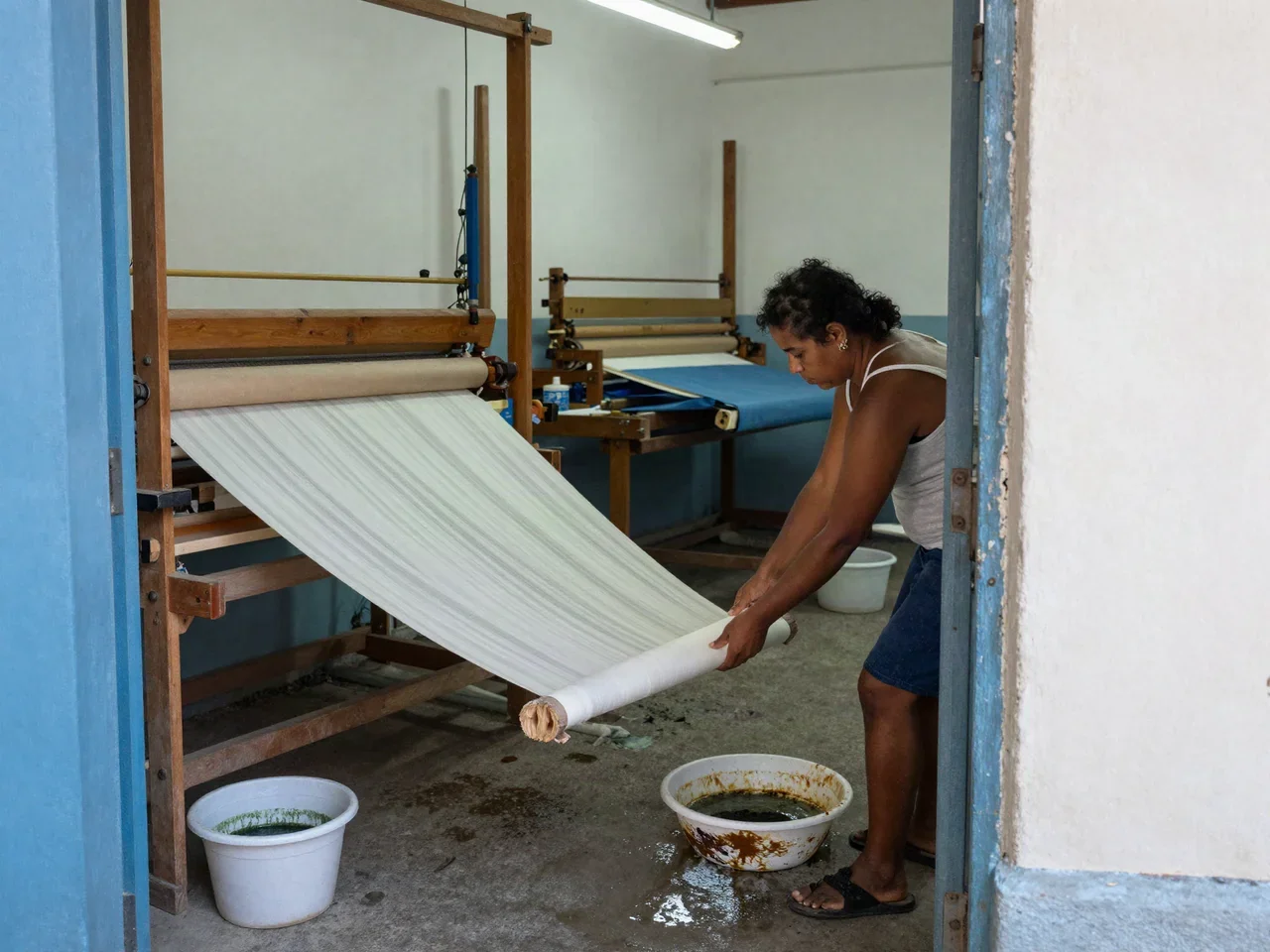
A different development was visible at Sharjah Biennial 16 in 2025. There, Dian Suci Rahmawati gave the material of daily work a form that let it be read at another distance. Based in Yogyakarta, Rahmawati studied the lives of women workers on Java’s northern coast, including work carried out in households for larger supply chains. In Larung: May the Blooms Be Carried Safely through the Night, she used dyed cloth, carved wood and, in one work, a wooden palanquin with a lamp. The Sharjah presentation included materials dyed with betel nut and sappanwood. A length of cloth can be suspended so that its pattern can be taken in at once. It can also be read as the accumulated result of a series of decisions about cutting, coloring and handling. These are different scales of attention to the same material.
Rahmawati is a name to follow for the way she makes the domestic legible as a place of production. Her work can sit in a room where cloth, light and carved wood invite a visitor to look carefully at their finish. The account of labor carried into homes then changes what a careful look has to consider. A small task such as sewing on a button may be easiest to overlook when the finished garment looks complete. The exhibition gives time to the individual steps that completion tends to conceal. It also brings attention to Jepara, where the project’s research was based, as a place in which craft, manufacturing and working lives have changed together. The route from there to Sharjah matters because it gives the work another public while retaining the question of where production takes place.
Another Indonesian artist in the same biennial, Rully Shabara, put the authority of the exhibition display itself under pressure. Known for his work with the experimental music duo Senyawa, he has made the voice a way of testing the range of sounds that listeners can recognize as organized speech. His installation Khawagaka presented artifacts and manuscripts as if in an archaeological display, with an audio track recounting stories of the Wusa civilization. Its language and history were invented. The Sharjah Art Foundation describes a script drawing on Javanese and Arabic forms. The work has the components of a record whose parts seem to confirm one another. A sound accompanies a script, and the script is given objects and a history. The display makes it possible to notice how these relations encourage assent even before a reader can make sense of a single sign.
Shabara’s work opens a problem close to Rahmawati’s, by a different route. She draws notice to people whose work can become difficult to trace once its products are complete. He gives things a provenance so persuasive that their moment of production can disappear behind an imagined past. One practice makes the route into the exhibition easier to investigate. The other allows the exhibition to demonstrate how easily a route can be supplied after the fact. It would be a mistake to generalize either move into a national style. What the examples in Java and Sharjah have in common is the precision with which they let a visitor ask who had a hand in making the work available, whether as a tile, a garment, a voice or a thing behind glass.
A roof tile sounded in a group, a cloth whose finish depends on labor often kept out of view, and a manuscript presented as a relic all make different demands on the institutions in which they appear. Each also leaves something for another institution to do. A workshop can pass on a technique. A gallery can make a stage of production available to scrutiny. A museum can invite visitors to think about the authority of its own arrangements. The question of which of these functions travels with a work becomes especially clear in Brazil, where a biennial exhibition has taken some of its contents to a city in which one of its artists developed the practices on display.
In the installation photographs of Alberto Pitta’s contribution to the 36th Bienal de São Paulo, lengths of patterned cloth hang from above. Some can be seen across the room, with space between them. The disposition is important because Pitta’s fabric has often been seen under other conditions, worn by people moving through Salvador during Carnival. There, a person can see the same pattern arrive on several bodies and disappear into a crowd. In the pavilion in São Paulo, the cloth can remain in view long enough to make repetitions and interruptions legible on its surface. The difference is one of the subjects an installation of this work can make available.
Pitta’s participation brings a long history with it. In the Bienal’s catalogue, Hanayrá Negreiros traces his practice to the life of a Candomblé community in Salvador and to the work of his mother, Mãe Santinha de Oyá, an embroiderer, educator and spiritual leader. From the 1980s, Pitta developed designs for several of Bahia’s Afro-Brazilian Carnival groups. In 1998 he founded Cortejo Afro. One of his characteristic procedures is printing white on white, a relation of colors that can become easier to see when fabric shifts in the light. A museum may give such a work a steady, favorable angle. A moving body gives it changes of light and perspective, and can put it beside other fabrics before anyone has decided which one to look at. The procedure is sustained in both settings, with different consequences.
There is a current reason to follow Pitta in Salvador. The travelling programme of the 36th Bienal is at the Museu Nacional da Cultura Afro-Brasileira through November 29, 2026. Curated for Salvador by Keyna Eleison and Thiago de Paula Souza, the selection includes Pitta alongside artists such as Nádia Taquary, Myrlande Constant and Théodore Diouf. It brings together works whose materials and routes can be thought through from Bahia, where viewers can have a history with some of the practices on display. A work travelling there does something different from extending the reach of an exhibition in São Paulo. It can enter an arrangement in which part of the evidence for understanding it is held by the audience. A reader following the itinerary should look at the changes in the group of works as closely as at the fact of their travel.
Aislan Pankararu, another participant in the 36th Bienal, offers a second point of entry into painting in Brazil. Caio Bonifácio’s catalogue text follows his moves from the Pankararu community of Petrolândia in Pernambuco to Brasília and then to São Paulo, where he encountered the Pankararu community in Real Parque. There is an earlier movement in this history. The flooding associated with the Itaparica dam in 1988 transformed places linked to Pankararu spiritual life. Bonifácio connects Pankararu’s early drawings of straw garments known as praiás to that history, and describes a subsequent practice using white clay on brown kraft paper. The combination recalls a relation between white pigment and skin while giving the marks a surface that can be handled, shown and looked at in its own right.
Pankararu’s paintings deserve sustained attention for the way a graphic sign changes when it is given a new surface and a different scale. A dot can suggest a unit in a repeated pattern at one distance and appear attached to a branching or proliferating form at another. The catalogue also relates his visual language to his experience with microscopy in medical training. That suggests a way of looking at the paintings in which a form can bring together different registers of knowledge. What matters to the encounter is the way the marks are made to behave together. A painting can let the viewer see relations between forms while some of their meanings remain held by people with a more direct relation to the practice that produced them.
There is an earlier, particularly forceful example of what can happen when a Brazilian practice occupies an entrance abroad. At Venice in 2024, the Huni Kuin Artists Movement, MAHKU, painted a large mural on the façade of the Central Pavilion. La Biennale’s account identifies its subject as kapewë pukeni, the story of an alligator that carries people across a passage under an agreement that eventually breaks down. The group took shape after drawing workshops in the upper Rio Jordão region in Acre, near Brazil’s border with Peru. The choice of a façade gives the work two immediate scales. It can be seen from a distance by someone using the building as a point of orientation. It also has a story that takes longer to understand than it takes to cross the threshold. A mural in that position can change the character of an arrival before the visitor has reached a label.
MAHKU, Pankararu and Pitta offer different reasons to keep watching what Brazilian institutions make visible. With MAHKU the scale of a collective practice can be felt in the relation between a shared narrative and the surface it occupies. With Pankararu, the continued transformation of graphic forms as they pass into paint, straw or ceramics is worth following. With Pitta, the relation between the work displayed and the public that has learned to see it in motion remains a live concern. A report organized around a single national tendency would lose much of the reason to follow any of them. Their work gives us more exact places to look, including Acre, Pernambuco and Salvador, and more exact questions to ask of an institution that decides to bring them together with other practices.
Back in Dakar, the cardboard has an address even if no one can say how long it will remain there. The exhibition that receives it can give it a title, preserve it and make it available to people who would never have come across it on the pavement. A visitor can also leave with a reason to look at the pavement differently. That second movement matters. A successful invitation makes a work visible to another public. The encounter becomes more consequential when that public also has a way to recognize the people, skills and places that were making the work visible before it arrived.