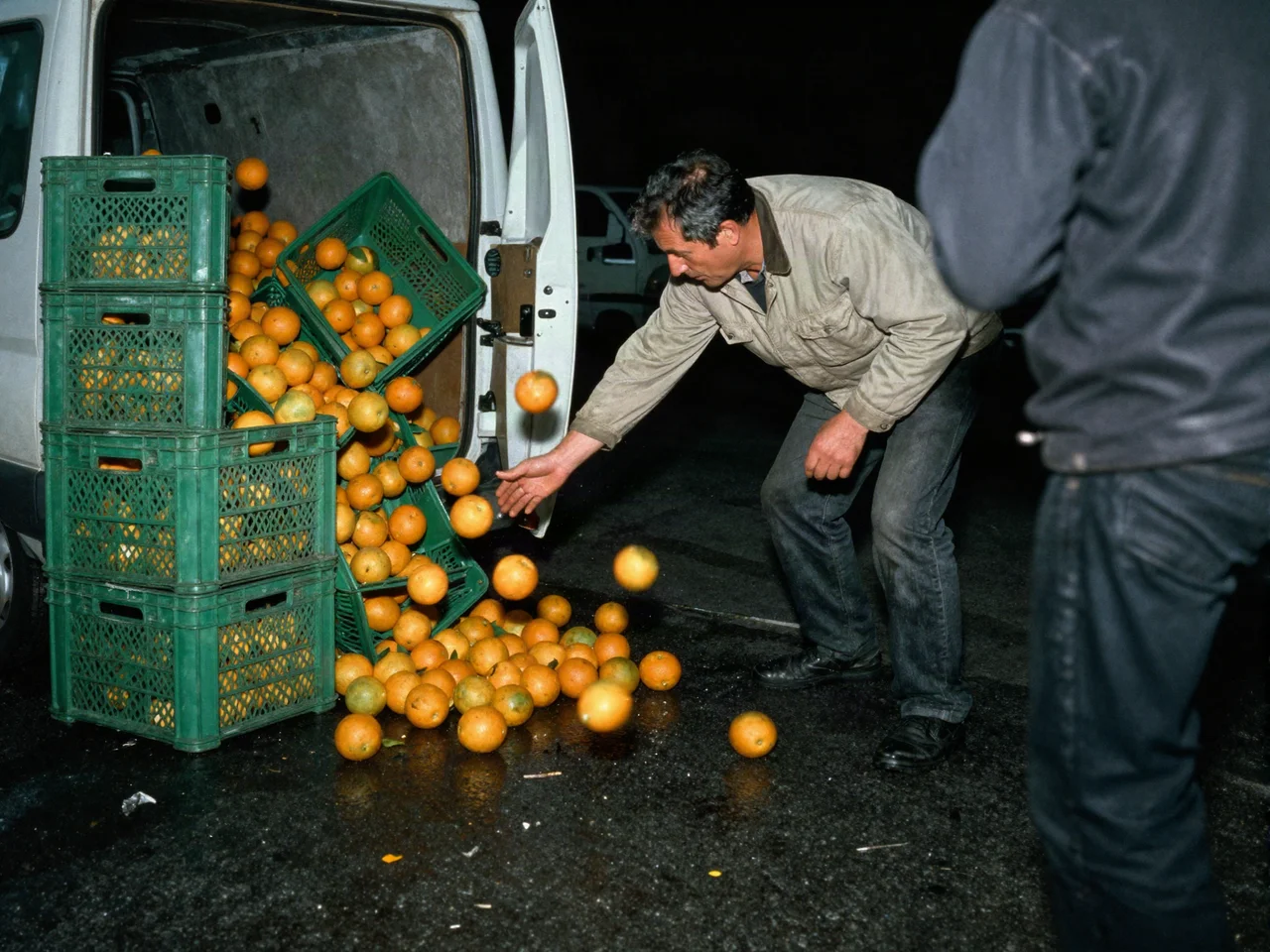
Several of the oranges are still in the air. The flash has picked them out against the dark, clear of the green crates and the wet ground on which the others have landed. A man reaches into the interval between the van and the pavement. His open hand gives us a way to read the distance an orange still has to travel. One stack of crates remains upright. Another tips out of the van, its grid of plastic working for a moment as a chute. The upright stack and the tilted one are made of the same things.
There is a sense in which this is already a sculpture. The oranges have weight. The crates interrupt their fall, and the ground gives their movement a new direction. Where one orange lands changes where another can go. We can read these relations before we know who is there, what happened just before the exposure, or where the van was going. The photograph arrests an arrangement that is still changing. Its clarity makes it easy to imagine that the arrangement could have been the purpose of the scene. The man’s hand supplies evidence of a different purpose. The configuration is passing through the reach of someone trying to do something about it.
Ordinary life is full of such discrepancies between what people mean to do and the forms their actions produce. A folded square of cardboard keeps a table steady. A cable wound around a railing holds a gate in position. A few minutes of rain redistribute what collects against a kerb. In each case a person may have acted quite deliberately, although the arrangement we find there can exceed any one practical decision. The cardboard takes the weight of every meal served at the table. The gate pulls against the cable every time the wind changes. The form includes what happens after somebody has decided that the job is done. Its author is difficult to name because its making continues after that person has gone.
Brassaï approached this difficulty at the scale of the fingers. In the early 1930s, for the photographs known as Involuntary Sculptures, he isolated scraps of paper that had been rolled or twisted, along with bits of soap and toothpaste. A rolled bus ticket becomes a tight coil whose shape survives the absent hand. Enlarged and lit for the camera, it has enough detail to suggest that someone could have considered every pressure and turn. What a hand remembers about rolling a ticket, if anything, is the wait or the conversation that gave it something to do. The picture gives the record of that movement a duration which the action itself barely had. There is an author of the photograph, and an unknown person whose attention was probably elsewhere when the little object took shape.
Richard Wentworth’s ongoing photographic project Making Do and Getting By takes similar notice of the hand’s work but keeps more of the problem in view. A piece of material wedged between two surfaces is interesting partly because we can still work out how it holds. An image made in Islington in 1983 shows a sandwich wedged into a tree. It has the outward shape of a practical solution, though the task it solves is hard to recover. The crevice may simply have been the nearest available place to put something down. Elsewhere in the series, a doorway held open or an object kept out of the way can make the task easier to reconstruct. Precisely how long they were supposed to last is usually a matter for the person who actually needed them. Given a day or two, an improvised support can become a feature of a place whose other users have already forgotten that somebody put it there.
An unintentional sculpture is a material arrangement with a history of use, strain and adjustment. The accident may occupy a fraction of that history. A container has to be made, filled and stacked before it can fail in a particular way. The phrase is worth keeping for the forms whose causes are more numerous than their authors, and for the moment in which those causes become legible together. To call the arrangement a sculpture is to risk mistaking that legibility for somebody’s achievement. It can also give us a reason to stay with the evidence of how many different things had to happen for a form to come about.
Bernd and Hilla Becher brought the question of anonymous form to the scale of industrial architecture. In Water Towers (1968–80), they photographed structures built for the same task and arranged the prints in a grid. The frontal views and similar treatment of light make it possible to follow distinctions in load, proportion and support from one tower to the next. A reservoir can sit on a cylindrical shaft or emerge above a frame through which the sky is visible. The task of holding water was intentional, and the towers had engineers, builders and histories. It takes the order imposed by the photographic series for the relation between these separate structures to become available at a glance. Their anonymity concerns the ease with which we can grasp a common form while knowing little about the people and decisions that made each example possible.
Nan Goldin brings a limit to that way of looking. In Nan and Brian in Bed, New York City (1983), from The Ballad of Sexual Dependency, the bed holds two bodies whose orientations put them at different distances from one another even as they occupy the same small space. Goldin looks toward Brian. His face turns out of the exchange. A reading attentive to shoulders, bedding and the low yellow light can register something about this distance before it can explain it. Goldin is also inside the situation she photographs, and her own position gives the arrangement consequences for her that it will never have for us. Seen in the sequence of the Ballad, the bed belongs to a life that continues beyond the exposure. The camera can make a relationship spatially available to a viewer. What those positions mean remains dependent on the people who have had to live in them.
The act of pointing a camera at such a configuration has consequences of its own. From the far side of the van, the upright stack might obscure the fall. An earlier exposure might show little more than a container full of fruit. Keep the shutter open longer and a moving orange takes on a different outline. The cover brings the whole event to a peculiar scale. Its brightness makes the airborne fruit seem almost as available for comparison as the crates. The people at the van have less time for this than the reader of the picture. The camera gives its viewer an interval nobody in the scene could use in quite that way.
Alina Szapocznikow gave the camera an active role in Photosculptures (1971). She shaped pieces of chewing gum with her mouth and presented them in photographs made with Roman Cieślewicz. The scale of the image allows a bitten, pulled surface to take on the gravity of something carved or modelled by hand. The gum records repeated pressure from a part of the body we seldom think of as an instrument for making objects. Chewing is purposive under other descriptions and quickly becomes habitual. Szapocznikow’s decision to produce and photograph these pieces brings one such habit into the making of an artwork. Her authorship includes the decision to recover from the mouth shapes it could produce with almost no supervision. A difference of a few seconds spent chewing could have made a different sculpture available to the lens.
In A Quiet Afternoon (1984–85), Peter Fischli and David Weiss use the interval between assembly and collapse as the condition of a photograph. The objects have been put together for this purpose, and the view can be taken only while they hold. What the pictures ask of a viewer resembles what we do when something at home is about to fall. We try to identify which point is carrying the weight and how little it would take to make that point give way. For the artists, a precarious balance has to last long enough to be photographed. For the viewer it lasts without movement, however long the eye follows the arrangement. The pictures hold several possible endings open by suspending the moment immediately before them.
Gabriel Orozco’s Yielding Stone (1992) continues to acquire form through contact. Orozco made a plasticine ball corresponding to his own weight and rolled it in the street. The mass deforms and receives impressions under the pressure of its weight. The street lends it the ordinary debris and textures over which it passes. After several turns, the ball carries evidence of contacts that its maker could retrace only imperfectly. Seen beside Brassaï’s ticket, Yielding Stone lets us follow a similar distribution of pressure at another scale. Brassaï could infer the movement of a hand from the paper it left behind. Orozco specifies a body’s weight and lets us infer a terrain from what the weight took up.
An artist can prescribe the conditions under which a form will be made and leave part of its making to what enters those conditions. The photographer can wait for an arrangement to occur and then make an exact decision about when it becomes a picture. These are two ways of working at the boundary of intention. They also assign the work differently. An image can circulate under one name while the furniture, bodies or infrastructure visible in it owe their positions to many others. The strength of the frame brings that difference into view and can make it easy to overlook in the same instant.
Michael E. Smith makes the difficulty of assigning each thing its proper place almost bodily. A 2018 Untitled is listed as a chair and a sea turtle. Those two words are more disturbing for their brevity. We know the height at which a chair should receive a person and the kind of weight it normally answers to. The sea turtle brings with it an entirely different sense of a body’s weight and what supports it. The materials list requires only a conjunction. In the work, that conjunction interrupts the ease with which a chair becomes a background object and an animal becomes an image of a species. Smith’s decisions about what enters the room and where it appears make an accidental encounter seem plausible, even as its improbability keeps returning us to the fact that someone placed it there. In his work the chance meeting is often something the artist has had to cause.
The readymade offers a particularly clear way to see what is at stake in these different assignments of authorship. Marcel Duchamp chose a snow shovel in 1915 and gave it the title In Advance of the Broken Arm. The inscription and the choice make a claim intelligible without requiring a transformation of the implement by hand. Still, the manufactured shovel and the event in which a shovel happens to be useful are different objects of attention. Picture the shovel propping open a door while a person carries something through. Its blade, handle, the pressure of the door and the need to keep a passage clear would make a configuration with its own duration. The title Duchamp gives the shovel can travel with it. The form of that ordinary encounter belongs as much to the door and the length of the errand as to the shovel.
In the photograph of the oranges, the crate remains close enough to the fruit to suggest how it should have served. That proximity gives the scatter more than the beauty of an irregular pattern. We can run the scene backwards in our minds and understand, roughly, why somebody would have stacked these things together. The exposure gives us little of the time before that instant. The orderly stack beside the tilted crate provides what remains of an earlier state. The nearer we look at this evidence, the more the same pieces of plastic seem implicated in both keeping the fruit together and letting it pass. The scene draws its force from an arrangement whose appearance and practical purpose have already begun to come apart.
To look at this photograph for longer than the spill lasted is to have time that somebody else, in the picture, appears to need. One can keep tracing the position of the fruit while the man’s hand is held open indefinitely. In the space outside the picture a person might have had to pick up what could still be sold, find a sound crate, or clear the ground so that the van could move. The difference matters to any account of accidental form. Duration is distributed unevenly here. A spectator can linger with a configuration whose practical life depends, from one second to the next, on someone knowing how to end it. The pleasure of the photograph includes a view of work at exactly the point when the work may be least convenient for those doing it.
Abraham Cruzvillegas’s Autoconstrucción makes the conditions of such resourcefulness explicit. The term comes from the way homes were made in the Ajusco district of Mexico City where he grew up. A building could take shape over years as materials, money and help became available. A wall put up at one point had to make room for what the household could do at another. The resulting structure may contain sharp changes of material and passages of remarkable ingenuity. Their sequence holds information about access to resources. In the sculptures Cruzvillegas develops from this experience, the temporary fit between components can remain available to the eye. Part of what a viewer sees is a built history in which people could commit to a next step before the final appearance of the structure was within their power to decide.
It is possible to admire a local solution in a building while turning the duration of the problem that called it forth into a picturesque detail. Someone may choose to leave a joint exposed because it will have to be opened again. The word anonymous becomes awkward at this point. It describes the viewer’s distance from particular people very well. Applied to the building itself, it can make their work sound as though it arrived with the materials. Cruzvillegas gives us a reason to ask what had to be carried, negotiated or paid for before an odd relation between two objects was available for contemplation.
Mierle Laderman Ukeles approached the issue from the point at which a task is ordinarily repeated. In Touch Sanitation Performance (1979–80), she went through New York City’s sanitation districts, meeting thousands of workers on the job, shaking hands and thanking them for keeping the city alive. The performance changed who had reason to pause in front of the people whose work allows the street to look ready for use. Its relation to sculpture begins there. What we see on a pavement depends on what has just been put down, what can remain until morning and what somebody must load onto a truck. For Ukeles, the visible state of the city is inseparable from actions a person has to perform again tomorrow. Her work makes the duration of those actions available as a subject. The spill is one of the occasions on which we can see how much of a cleared street ordinarily goes without acknowledgement.
An institution can keep a fragile arrangement available for a long look. Its power to do that brings a responsibility for the conditions it takes away in the process. A museum can protect a remnant, date a photograph, or give the reader a name. The object might be preserved in excellent condition when the account of whose work sustained it has almost disappeared. An unintentional sculpture asks what we would put on the label if keeping that earlier life legible were part of keeping the form.
David Hammons made the life of a form depend on what could happen on a pavement. In Bliz-aard Ball Sale (1983), he offered snowballs of different sizes alongside other street vendors in New York. The arrangement had the plain order of goods set out so a customer could compare them. Anyone familiar with snow could also see how short a time a purchase might remain in the shape in which it was bought. That small conflict between the visible effort to sort the goods and the brevity of what a customer might acquire was available without the subsequent exhibition history of the work. Hammons needed a place where somebody could recognise a sale and reasonably wonder why these particular objects had been given such care.
The record of the sale includes photographs by Dawoud Bey. His David Hammons, Bliz-aard Ball Sale I keeps another seller in view. That person’s presence makes the way the snowballs occupy the street easier to understand. They were one offer in a place where somebody else had something to sell. The photograph lets us attend to a social proximity that a reconstruction of the array indoors would have to explain. It also outlasts the material that made the sale possible. Bey’s image has a circulation, a date of printing and a place in a collection that belong to the photograph. What survives of the sale is in part a second maker’s decision about the amount of street to include.
Much of the pull of the cover image comes from how little of the rest of the street it gives us. The figure at the right edge is close to the camera and partly cut off. Beyond the reaching man, the frame turns dark. We can see the places where the fruit is headed more clearly than the places either person came from. The temptation is to identify the sculpture with the scattering oranges and take the rest for setting. Yet the form starts with a container made to keep separate pieces of fruit moving together. It reaches into the bodies that shift around it and the patch of pavement suddenly required to receive it. The hand is still inside that chain of events. In a second it may close on an orange and return it to a crate. Each time someone succeeds at that small task, there will be a little less of the sculpture to see.