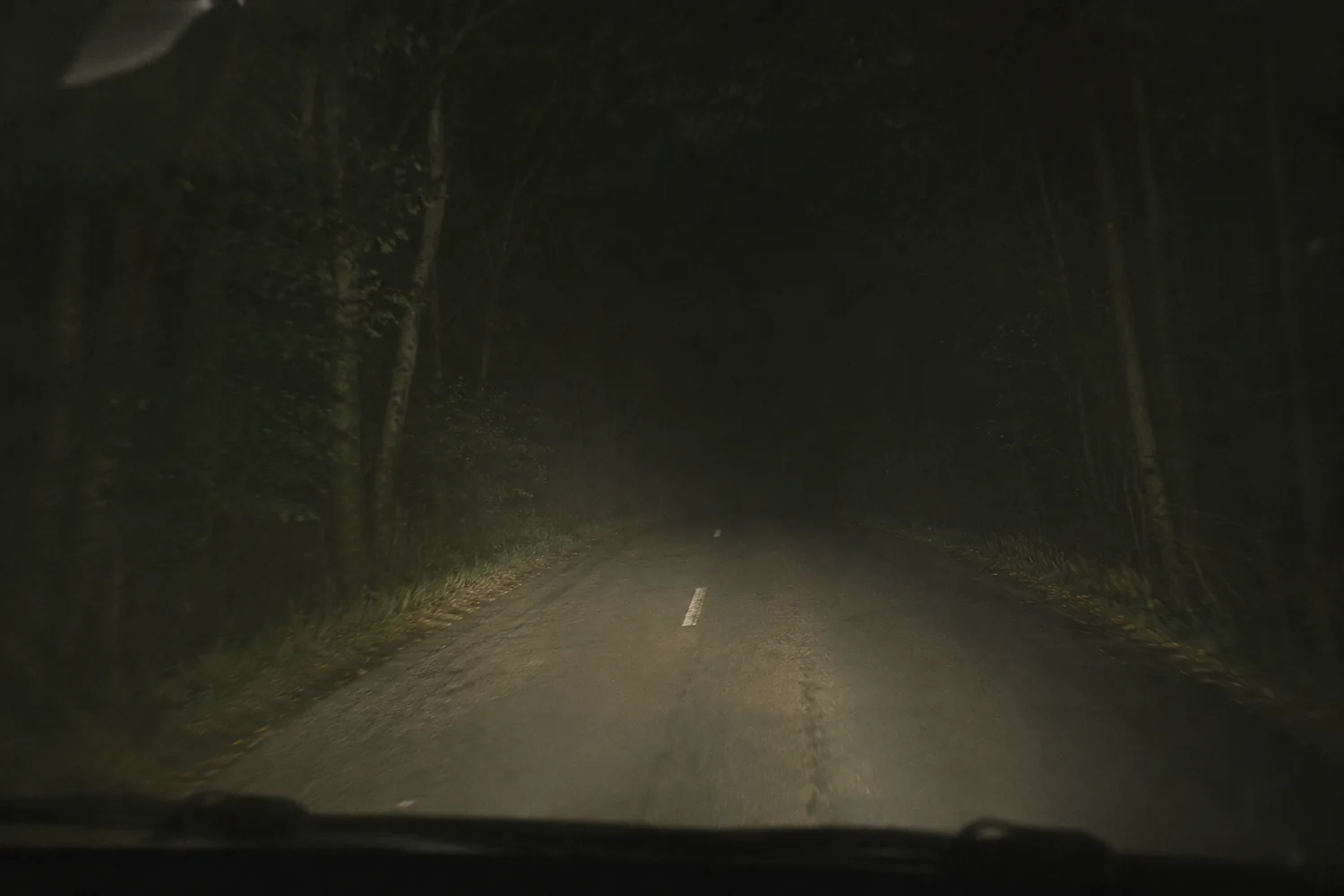
Four friends go out to get something to eat. They have recently graduated, and the trip begins with the small freedom of people who can get into a car together without making an occasion of it. In Alexander Ullom’s It Ends, a turn takes them onto a road that keeps going. There is enough road for the next stretch of driving and then enough for the stretch after that. The ordinary signs that movement is serving some purpose can remain in place long after the purpose has dropped away. A passenger can see that the car is moving. Nobody can say what that movement now amounts to.
The film gives that uncertainty to four people at an age when movement is apt to be taken as evidence of progress. Graduation does some of that work in advance. It supplies a date, an image of arrival and a vocabulary for asking what happens next. There is considerable pressure to make successive things add up, as though the relation between them will be as legible as the relation between one year at school and the next. The road in Ullom’s film asks what would happen if the same supplies of effort, deliberation and time ceased to produce that legibility. The question is felt before it can be answered, in the difference between the short distance made visible ahead and the distance the occupants need to imagine in order to believe they are getting somewhere.
On a normal drive there is little reason to make much of that difference. We can trust that a road seen a few yards at a time belongs to a longer route. The passenger can look away and come back to it. A word spoken in the car has the status of something that happened on the way, and a disagreement about whether to turn can be settled by seeing where the turn leads. Now suppose the distance fails to supply that verdict. The disagreement stays in the car. The judgments people make about one another begin to matter more because there is less evidence with which to decide whether any of them was right. An itinerary can ordinarily spare us the trouble of asking a companion what they think we are doing. Here that question has to be asked of someone who has had access to exactly as much of the road as we have.
A journey can end before it has told us where it was taking us. We are accustomed to waiting for the end to sort what happened into decisions, delays and mistakes. An arrival lets us treat the miles before it in a certain way. A termination leaves those miles harder to account for. In It Ends, the title can make a promise the road is under no obligation to keep. The film can bring our time with these people to a close even as we are still trying to decide what their time together has been.
In 1971 Nancy Holt walked into dense vegetation in the New Jersey Meadowlands with a Bolex camera. Robert Smithson called out directions as she moved. Holt’s lens was set to register things at close range, so that grass and stalks occupied the field through which she had to find her footing. In Swamp, the resulting film, we hear instructions that seem straightforward until we try to imagine carrying them out with this view. Walking straight might sound like a matter of keeping one’s body on a line. How much straightness can be judged by looking into plants that are already brushing the lens? A voice says which way to go, although the picture gives us little ground on which to decide how much the person speaking knows about what the person walking is encountering.
Swamp lasts the length of a reel of 16mm film. There is a satisfying clarity to that fact and very little corresponding clarity about the walk. An account of the route drawn afterwards could place it in a marsh on a map. It would have trouble including the unequal distribution of sight on which the walk depended, or what it took for Holt to decide whether to put weight on the next step. The sound and the picture preserve those two positions within the same undertaking. One person is trying to see for somebody else. The other is moving through what the first person describes. Anybody who has spent time in a moving car with someone giving directions knows that these are separate kinds of knowledge. We tend to notice the separation at the point when the directions become hard to follow.
Mieko Shiomi had approached direction as a question people could answer without going anywhere together. For Spatial Poem No. 2 (Direction Event), in 1965, she asked participants in different places to report which way they were facing or moving at a specified time. People who might never meet sent her accounts of an orientation. They could decide for themselves what the word covered. As the replies came in, it became possible to describe something they had done at the same moment, across time zones, without pretending there was a route capable of taking one person through all the others’ positions. In the correspondence around the work, direction concerned the relation a person could perceive between themselves and the world around them. The exercise grants that relation the precision we ordinarily reserve for the reading of a compass.
The reports in Shiomi’s work make it easier to reconsider those four positions inside the car. From outside, everybody appears to be going in a single direction. From within, they may be orienting themselves toward a friend, a certainty about what ought to happen, or a guess about how much longer they can tolerate being there. The car holds those bearings together for a while. Some can survive a change of scenery, and some change at the sound of a sentence. We often realise that companions have been moving differently only when one of them describes the journey later. Inside the car, even that later account is something they have to imagine.
A strip of masking tape laid on a studio floor gives Bruce Nauman a much more definite route. In Walking in an Exaggerated Manner Around the Perimeter of a Square (1967–68), he goes forwards and backwards along the edges of the figure. He sets one foot down in front of the other and amplifies the movement of his hips. The fixed camera includes only part of the square, so that there are moments when he has walked out of view. We know roughly where he must be. His reappearance is predictable, yet there is usually something to see in the way he re-enters the image. Our knowledge of where the next step goes makes it easier to notice the weight of the step and the labour of picking a foot up again.
It would take very little time to acquaint somebody with the rule of that walk. The considerable time spent watching it enables a different sort of judgment. What looks at first like the execution of a bare instruction becomes a negotiation with balance and with the conspicuousness of certain movements. A studio can sustain many of these intervals. Materials are brought out, handled and left near where they were found. From the standpoint of somebody expecting a finished work, much of that time is hard to see. Nauman makes it possible to see by choosing a task whose result is available in advance. By the time we have watched the turn at a corner several times, the location of the corner is perhaps the least interesting thing we know about it.
In Mexico City in 1997, Francis Alÿs spent hours pushing a block of ice through the streets for Paradox of Praxis 1. Early in the action the block was substantial enough to require him to lean into it. As it diminished he could move it with his foot. Eventually it melted. If one tried to tell the story of the day by describing the distance covered or what remained of the material, the burden of the work would be hard to recover. The heat that reduces the size of the block also changes the kind of effort the artist has to make. The simplest account of the action, pushing something until it is gone, contains a series of adjustments that a body has to learn while the thing it is handling ceases to be what it was.
That expenditure also belongs to a particular city and to an encounter with the forms of work visible on its streets. A block of ice had practical uses there. It was a familiar shape in a system of daily deliveries. When Alÿs puts the block to work as the object of an extended, apparently unrewarding task, he exposes the ease with which effort can be discounted once the thing it was supposed to deliver is gone. There is a difference between encountering that imbalance as part of a work of art and depending on the result of a day’s work for a living. The artist can design an action around the disproportion. The person whose work is regularly measured against an outcome they are poorly placed to control encounters it as a condition. That difference gives the work some of its friction.
In a life, a repeated act can answer to somebody else’s need. Taking a turn on a long drive, staying on a call a little longer or making the same meal again does very little for a story that expects its episodes to build towards a result. The repetition is often exactly what another person needs to be able to count on. If we ask only whether the miles have brought the car closer to an exit, the decision to take somebody’s place at the wheel registers as almost nothing. The person who has been driving experiences it differently. A measure capable of registering the distance will have trouble registering the relief.
In David Lamelas’s Time, first performed in 1970, participants form a line. Someone announces the time and the next person waits a minute before announcing it in turn. At the scale of public time, what happens is familiar and perfectly easy to reproduce. Within the line the minute has to pass through somebody. The person responsible for announcing it next is waiting in a different sense from the people farther down, who have yet to receive the signal. A clock can give all of them the same information. The work depends on their agreeing to receive it from one another. That makes sixty seconds something a group can give a shape to, with bodies distributed across a room and a voice audible from one place at a time.
Lamelas regarded the performance as a kind of sculpture. A useful way to take that proposition seriously is to consider where its limits fall. The line has ends and there is a last person to speak. The work could pass through a longer line, or a shorter one, without changing the underlying unit. Its extent depends on the people who have come to stand there. A participant can readily imagine a further place being taken up beyond the end of the line. The difference between that imagined participant and the one who actually waits is that the latter spends a definite amount of their own life in the arrangement, even if they could describe very little as having happened during it.
That is something a passenger in Ullom’s car might understand better than a spectator. From a seat in a cinema it is natural to assess the value of an interval from what the next scene does with it. For the occupants, the interval is also something they are giving to the others, or asking the others to give, in the absence of a reliable account of what it will buy. Each time someone wants to continue, that decision makes a claim on the time of whoever would prefer to stop. As the miles accumulate, the claim can become more consequential than the explanation offered for it. A later account may say simply how long they were going. Within the car they still have to decide how to spend the length of road that is coming into view.
In Laura Grisi’s The Measuring of Time (1969), a pair of hands picks through grains of sand. The camera moves out in a spiral until we can see the figure sitting on the beach, then moves back until the hands fill the frame again. We have spent several minutes with the count by the time the film returns to the scale at which it began. The grains are still small enough to require attention one by one. If the film stayed with the hands for much longer, the next movement could be almost the same as the last one we see. There is a finish in the movement of the camera. It has gone out and come back. The gesture inside the resulting figure has a different relation to the end.
A count is usually useful because it can deliver a total or tell us how far we have got towards one. Grisi sets it to work on a material whose abundance makes that function largely unavailable. Somebody can take an exact count seriously at the level of the next grain without having any practical way of deciding how far through the sand the count has got. The choice to bring the camera back gives the film a rounded form. It also lets us see how little the artist’s hands need that form in order to carry on. We can have the experience of being given an ending at the very moment when it becomes evident that the action has yielded no reason for ending there.
Roman Opałka made a related problem the condition of a painter’s working life. In 1965 he began to paint consecutive numbers. Each canvas continued where the last had stopped. A painting could be filled and put aside while the number at which it stopped remained available as a starting point elsewhere. He later made the grounds progressively lighter and added recordings of his voice counting as he painted. As the surface grows paler, the continuity that can be so easily described becomes harder to follow by looking. In the recordings there is another sort of access to it. There is the voice pronouncing the numbers, and there is the slight interruption while the brush is reloaded. Someone encountering one of the canvases can look at it for a fraction of the time each row required. The pauses begin to give that expenditure an audible size.
Opałka continued the project until his death in 2011. Given any number on one of the canvases, we could say which number he would have had to paint next. That prediction could never tell us how many numbers he had time to paint. The means of continuing was exceptionally clear and the extent to which the painter would be able to continue was, for most of the working life of the piece, unknown. Grisi could choose where the camera returned to her hands. The particular number at which Opałka’s work came to an end has the standing it does because the body that was doing the counting eventually ceased to be available for it. The procedure gave the painter a way to go on through interruptions, from one session to the next. It makes the final interruption immediately legible while withholding any assurance that there was something special about the figure at which it came.
Most of us know what it is to discover the last occurrence of something after the fact. The last time someone visited, you may have spent part of the afternoon moving a chair into the light or looking for a second glass. You could mistake the visit for one of an indefinite number of visits, which was part of the ease of having it. The next one was available to the imagination in much the same way as all the others. When the visits stop, the ordinary detail acquires a distinction it had offered no reason to expect. Nothing about where the chair stood could have instructed you in what you were living through.
There is sometimes an impulse to make the last encounter bear the full weight of what came before, to go back to it and ask it to yield a sentence that could explain the relation. An ending does change the way earlier things are available to us. It makes certain memories easier to find, puts others strangely far away and gives some moments a shape that was difficult to see from within them. This new disposition can be mistaken for knowledge that we ought to have had at the time. Opałka’s procedure leaves us with the difference. We can locate the last number by working back from the end. From where the person painting it sits, most of the practical knowledge required is about how to put the number on the canvas.
The road in Ullom’s film has a similar precision at the scale of what is immediately ahead. The occupants can see enough to keep moving. They know that another small stretch of time will have to be spent somehow, and they know who is there to spend it with them. Their difficulty comes in trying to gauge that small expenditure by the account of it they would be able to give if they reached somewhere else. It is possible to spend a long time with somebody while both of you reserve judgment about what that time is becoming. There is a real intimacy in having to decide something together under those conditions, before there is a story that can make the decision look sensible.
A film can give us back a view of the road at the moment it takes the road away. We are then free to look back upon the events, with a leisure the people in the car could scarcely have imagined. The temptation is to decide, from that new position, at which point they had the information they needed. Perhaps there are small things we can see more clearly by supposing that they never had it. Someone must have listened long enough to notice a change in how another person was speaking. Someone must have looked out again after being certain that there would be nothing different to see. Those small acts are among the reasons to stay with the journey, even after we understand that the road has no explanation to give us.