From the aisle of an art fair, a painting might register as a patch of red beside the name of a gallery. A few steps closer, the red separates into two fields, one thin enough to let the ground show through. Getting close enough to see that difference takes a change of direction. You have to turn your shoulders, let someone pass, then find a position from which the light stays off the surface. The opening to the next booth is still visible to your left. Even before you have decided what to make of the painting, you have decided whether to stop. The works further down the aisle have already entered into that decision.
The sensation of having seen too much can begin surprisingly early in a visit. It is possible to feel it while standing in front of the third painting of the day. What presses on the encounter is how much there is still to see and how hard it is to estimate what any of it will ask of us. Two minutes spent on a painting with a surface that changes as we move might disclose something singular or leave our first impression intact. Two minutes spent walking promise half a dozen fresh impressions. The comparison is easy to make from the aisle, where we already have evidence of the next impression and very little evidence of what a longer look might yield.
Art Basel’s published floor plan for its 2025 Basel fair lists 289 galleries. The map gives that number a form. Each participant has an address and each block of addresses can be fitted into a visit. There is genuine relief in this. A name we have wanted to find all morning need no longer be a matter of chance. Yet a map is also good at making a visit look finishable. A booth marked with a letter and a number occupies no more time on the page than the booth beside it. The differences between them return the moment we stand at their entrances. One might contain a suite of works with an order worth following. Another might put objects from several decades within a few feet of one another. From the corridor each still appears as one more place we can tick off.
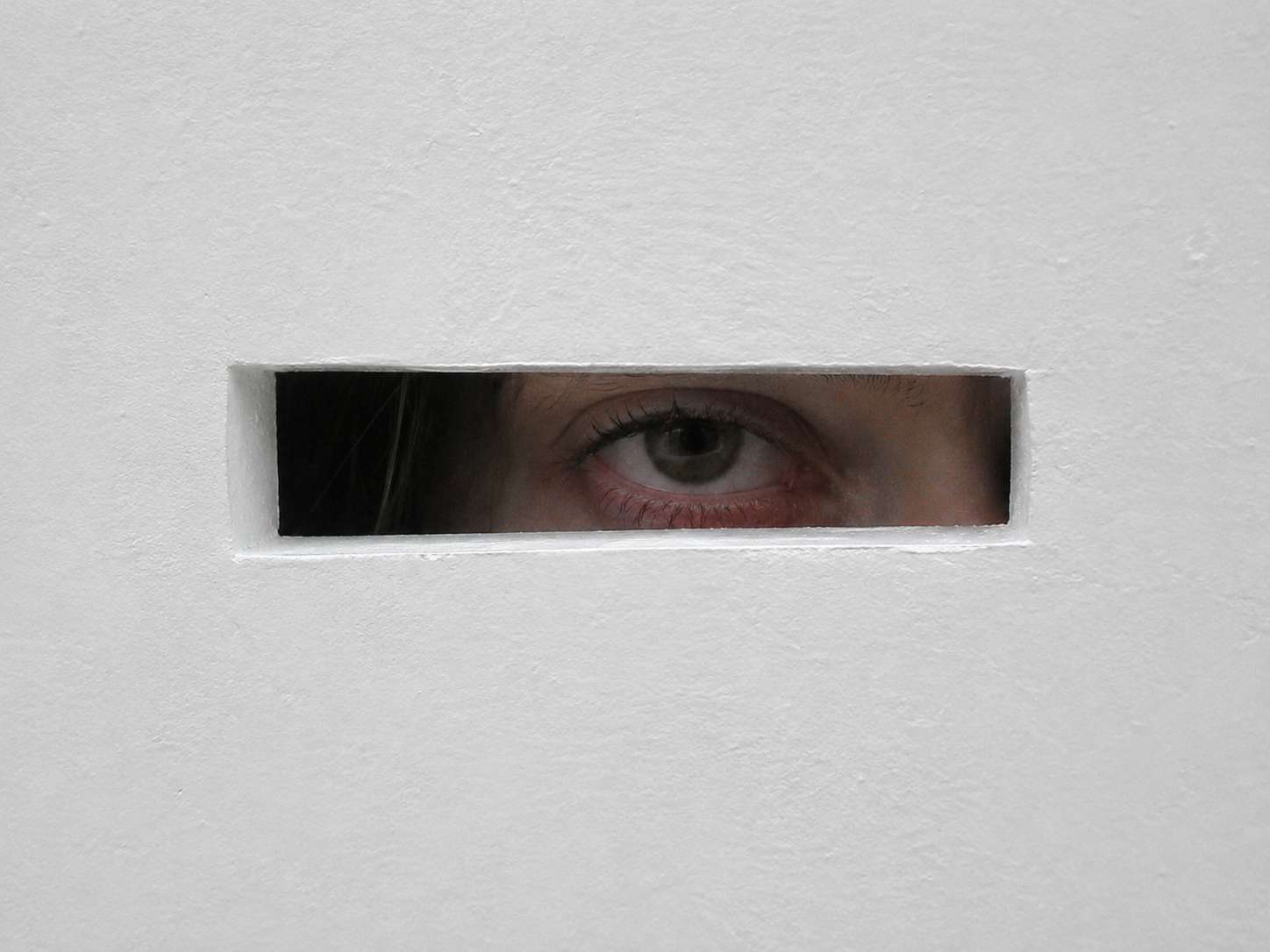
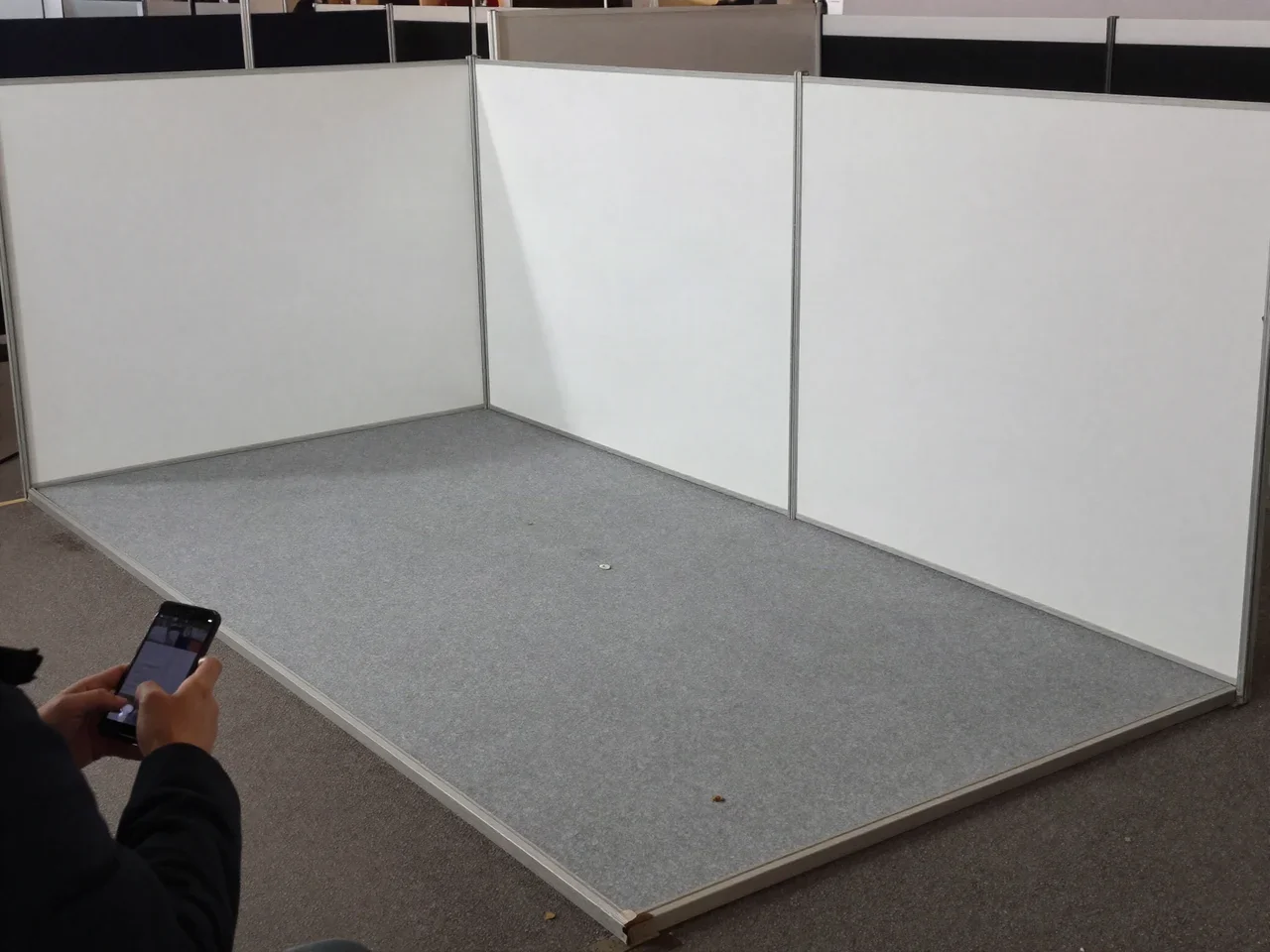
The booth puts an unusual amount of pressure on the threshold. Within the allotted space, a gallery can arrange things to make a precise argument about an artist or a historical relationship. A mesh hung in front of a wall may be intended to catch the shadow of a sculpture on the other side of the booth. A person looking inward from the aisle might see the mesh first and assume the shadow belongs to it. Both readings are available in the same arrangement, under different conditions of attention. The booth often has to give the passerby a reason to enter before it can provide the conditions under which that reason becomes interesting. A work that reads immediately at the threshold can perform the first task for another that takes longer to disclose itself.
There is a pleasure in the abrupt comparisons a fair makes possible. One can emerge from a space full of smooth, hard-edged surfaces and find oneself suddenly aware of the drag of a brush across linen. The adjacent galleries may have had no intention of setting up that comparison. Their temporary proximity is precisely what gives it force. A fair lets us make connections that would be cumbersome to verify across separate cities, collections and decades. It also favors properties that hold steady while we move. A large or highly saturated work can stay distinct across an aisle. A distinction between two kinds of matte paint may disappear from the same distance. The two effects can be equally deliberate and have very different chances of becoming the reason someone stops.
The timing of the fair begins before the doors open. The same 2025 plan that organizes galleries by address also divides access by passes and hours. A first group can enter while other groups must wait, and the advertised public days follow several earlier viewing opportunities. These distinctions matter even to the experience of a visitor who has come purely to look. A collector with an appointment can approach a specific work as the main event. A visitor with a single afternoon may have to fit it into a trip across the hall. The object is available to both, and the room grants it the same square footage. The amount of time they can afford to leave unassigned is already different.
In 1974, at the Claire S. Copley Gallery in Los Angeles, Michael Asher removed the partition separating the exhibition space from the back office. The Michael Asher Foundation describes the intervention as a disclosure of the gallery’s everyday operations. The considerable thing about the gesture is how little it added to the inventory of things to see. The office acquired a different status because the visitor could now see it from the space where a work was expected. An ordinary delay, the kind that comes with watching other people go about their work, could enter the encounter. At a fair the public face of a gallery and its business are often visible in the same booth, and the partition may amount to a person standing between a conversation and a painting. Asher’s intervention helps locate the pressure in that arrangement. The same floor space has to accommodate the tempo of looking and the tempo of a transaction.
A fair visit is therefore partly an exercise in reading the conditions under which things are offered to view. Some of those conditions are legible only after we have left a booth and can see how its opening faced the traffic. Others become apparent when we turn back and find the work we had noticed obscured by a conversation or newly visible across an empty stretch of aisle. Those changes are easy to file away as accidents. They tell us, though, how much looking depends on the possibility of making a second approach. An exhibition with plenty of room and a coherent curatorial sequence can seem to offer an escape from this problem. It can also put more before us than any visit could accommodate. The difference is what the exhibition does with that fact.
The installation photographs of Hanne Darboven’s Kulturgeschichte 1880–1983 show frames in lines extending across the walls and through more than one room. A person standing well back could probably count the rows before locating a single subject. Dia Art Foundation records 1,590 works on paper and nineteen sculptural objects in the installation, which Darboven made between 1980 and 1983. The frames set out a regular pattern that the photographs make particularly legible. Inside them, publicity photographs, postcards, magazine covers and handwritten material have very different kinds of edges. Some images have already been cropped, reproduced and given a caption before they enter Darboven’s arrangement. The work gives these existing units of attention another scale and another set of neighbors.
One way to begin would be with a postcard. A postcard promises a view that can be withdrawn from a place and made available elsewhere. It usually includes enough information to recognize what has been saved from the surrounding scene. In Darboven’s installation, the card may be small enough within the frame to require an effort before it can do this work. Look closely and it becomes possible to see how it presents the place. Look away and it becomes one rectangle in a row again. A magazine cover nearby can propose an entirely different public image of history, with a subject made urgent by repetition across copies. The recurring frame allows these materials to meet. Their dimensions within that frame, the distance at which each becomes readable and the ease with which we already know how to read it remain unequal.
The difficulty of seeing the work in full comes from the arrangement itself. From a distance we have a good view of the grid. The writing becomes legible only when much of that grid is beyond the part of the wall we can attend to. What looks, from the far side of the room, like an insistence on continuity becomes, close up, a series of discrepancies between kinds of record. The work requires the visitor to shift between those scales, and the shift changes the significance of what has just been seen. A sheet recognized as one small part of a wall may turn out to contain a statement of considerable historical violence. At that point the regularity of the wall begins to look less reassuring. There is a great deal of material here, and it matters that the demand it makes is specific enough to survive an incomplete visit.
This also changes how we might think about museum displays organized around chronology. A sequence of rooms can make it possible to understand a development that would otherwise remain hard to follow. It can also confer significance on whatever appears as the last or largest example of that development. The advantage of a legible sequence is inseparable from its power to settle what belongs where. Darboven draws on recognizable means of ordering time, including dates and recurrent formats, while making the inference from sequence to significance difficult. One fragment may reward three minutes of attention and the next may yield its public meaning before we have fully stopped. The arrangement makes room for the resulting irregular rhythm. We can leave without having finished, with an idea of where we might enter on another visit.
Christian Marclay’s The Clock offers a different kind of point of entry. Its thousands of film and television excerpts make up a twenty-four-hour montage synchronized with the time where it is shown. At eleven fifty-three, a viewer walking into the room can meet eleven fifty-three on screen. In many of the fragments, a watch or a dial was originally a cue within a story. Someone was about to be late, a departure was imminent, a character wanted to know how long they had left. The excerpt brings that urgency into the room and gives it a second obligation. It has to tell the time for people who arrived with stories and appointments of their own. The editing keeps those overlapping claims in play. Recognizing a film can be one reason to pay attention, and the larger structure carries on when the clip changes and the recognition falls away.
At the Museum of Modern Art’s 2024–25 presentation, the visitor guidelines set out another measure of duration. Seating was limited. Members had priority. Once admitted, visitors could stay as long as they liked during opening hours, but leaving meant joining the queue again. The film makes the beginning available at any minute. The room can admit only so many beginnings at once. A sequence that seems to belong to the shared time of the city is experienced differently by someone already sitting and someone whose phone is telling them how long they may have to wait. The friction is particularly sharp here, because the sense of having something else to do in twenty minutes participates in the very work one has come to see.
There is a temptation to take these installations as endorsements of a slower kind of looking. Their specific achievement is more demanding. The Clock depends on rapid succession, and a brief stay can disclose its basic operation with considerable force. Darboven can overwhelm in an instant, at a distance from which almost nothing on the sheets can be read. A short encounter has a form in each case. Its value turns on what the work allows the visitor to do with the time available. That raises a question about the large exhibition that offers a single route through several rooms and puts the most legible account of every work at the entrance. Leaving early may mean that most of the experience takes place with the promised whole still ahead, so that what we actually see comes to feel like the incomplete version of a visit we managed mainly in our heads.
A visitor can remember the entrance to a film at a particular minute and never see that minute again on a return trip. A sheet in Darboven’s grid can remain in the same place and still seem altered by what we have since looked at nearby. Both experiences expose a limitation in the familiar wish to see everything. Seeing more changes the conditions under which an earlier thing can be seen a second time. The sequence through which the change occurs may leave no visible record in the room. We often make one ourselves as we go, on a device that has its own way of arranging what it receives.
A photograph taken at a fair often includes the label. This is a small concession to a future in which the image alone will prove insufficient. There may be two photographs, one of the painting and another of the card beside it. Separated in a camera roll, the two have to be put together again by someone who remembers which gallery wall they shared. A third photograph, made from further back, might show the installation and explain a detail the frontal view left obscure. A minute spent with the three images can produce a more exact question about a painting than the minute in which they were taken. It can also reveal how little we saw while trying to get a clear photograph.
The camera roll carries an order of its own. A painting that took up most of a wall and one that could be held in a hand appear inside frames of the same dimensions. Their relative sizes survive only where the photographs include a floor, a hand or another comparable object. Glare may cover the part of a painting that interested us. It may also preserve the evidence that we had to look from an angle. Next to a photograph of a train timetable, the gallery view can recover something about the visit that an isolated reproduction would lose. The roll makes objects comparable in ways their display did not, and joins them to parts of the day the gallery would have had no reason to record. Revisiting it involves a second selection that can turn a hurried encounter into a study of a few related details. That takes time in its own right.
A photograph can also make the people looking at art visible in a way a clear reproduction of the art rarely does. In Thomas Struth’s Louvre 2, Paris, 1989, children sit on the floor in a loose circle beneath a large painting. SFMOMA’s account draws attention to a child in a yellow and gray jacket looking back toward the camera. The group has enough visual weight to be noticed before any one face is distinct. The turn of the child’s head can then send our attention back through the picture. We see the other children differently because we know that at least one of them has registered the photographer. The museum identifies the unseen Mona Lisa as being off to the right. The information gives us a sense of where another visitor’s attention might have gone without changing what the print allows us to see. Looking at Struth’s photograph means attending to people who are themselves in the process of deciding where to look.
The photograph predates the routine of making a digital record of every room. It is useful here because it separates the presence of an image from the attention it receives. Struth’s frame holds the children long enough for their positions to become as consequential to the composition as the paintings behind them. Yet that arrest is achieved at the cost of whatever the children did next. A visitor now photographing the painting over their heads might wait for them to move out of the frame. Both camera positions produce something intelligible, and each leaves something important outside. When a visit has become too crowded to remember distinctly, the question is what kind of reconstruction its images permit. A record of everything won’t necessarily tell us how we came to care about any of it.
There are practical consequences to making the conditions of a visit readable. A room photograph can show whether the low edge of a canvas was almost touching the floor. An object detail can explain why distance matters in the first place. A fair guide can help someone find the booth again even if they spent their first visit looking across it. These are modest functions for documents often expected to stand in for the experience as a whole. They make a visit capable of continuing in another medium, with a specific question left to answer. The images that perform those functions may reach people who never had the option of entering the building, which is one reason the distinction between viewing and documentation is worth keeping precise.
It is easier to tell a visitor to slow down than to organize a room in which stopping is possible. Consider the difference between a seat facing an artwork and a bench outside a room for people who have already had enough. Both offer a break. Only one allows a tired person to stay with what they were looking at. A similar difference exists between a route that carries everyone past a painting once and an arrangement from which the painting can be encountered on the way back from somewhere else. These decisions seem minor next to the choice of artists or the argument of a show. They exercise a considerable influence over which comparisons a visitor can actually make. A seat or a return route cannot guarantee an encounter. Either can give a visitor time in which something they had passed over becomes worth another look.
Some works become legible only after other things have been seen. A display can leave room for these later encounters. Darboven’s frame lets us locate a fragment in a sequence that remains beyond our grasp. Marclay gives each arrival a shared minute and makes its continuance contingent on a place in the room. Struth notices that someone in the process of looking can become part of what there is to see. Together they make it possible to imagine an exhibition in which the act of passing by belongs to the experience and the visitor has occasional means of reversing it.
On the way out of the fair, the red painting comes into view again. From the aisle it is the same size, and the surface is as difficult to distinguish. We can now locate it by something more particular than the gallery name. We recognize the thinness of the color near the edge because we remember having turned to see it. A second look begins from that slight difference. This time the opening to the next booth is still in view and can wait.