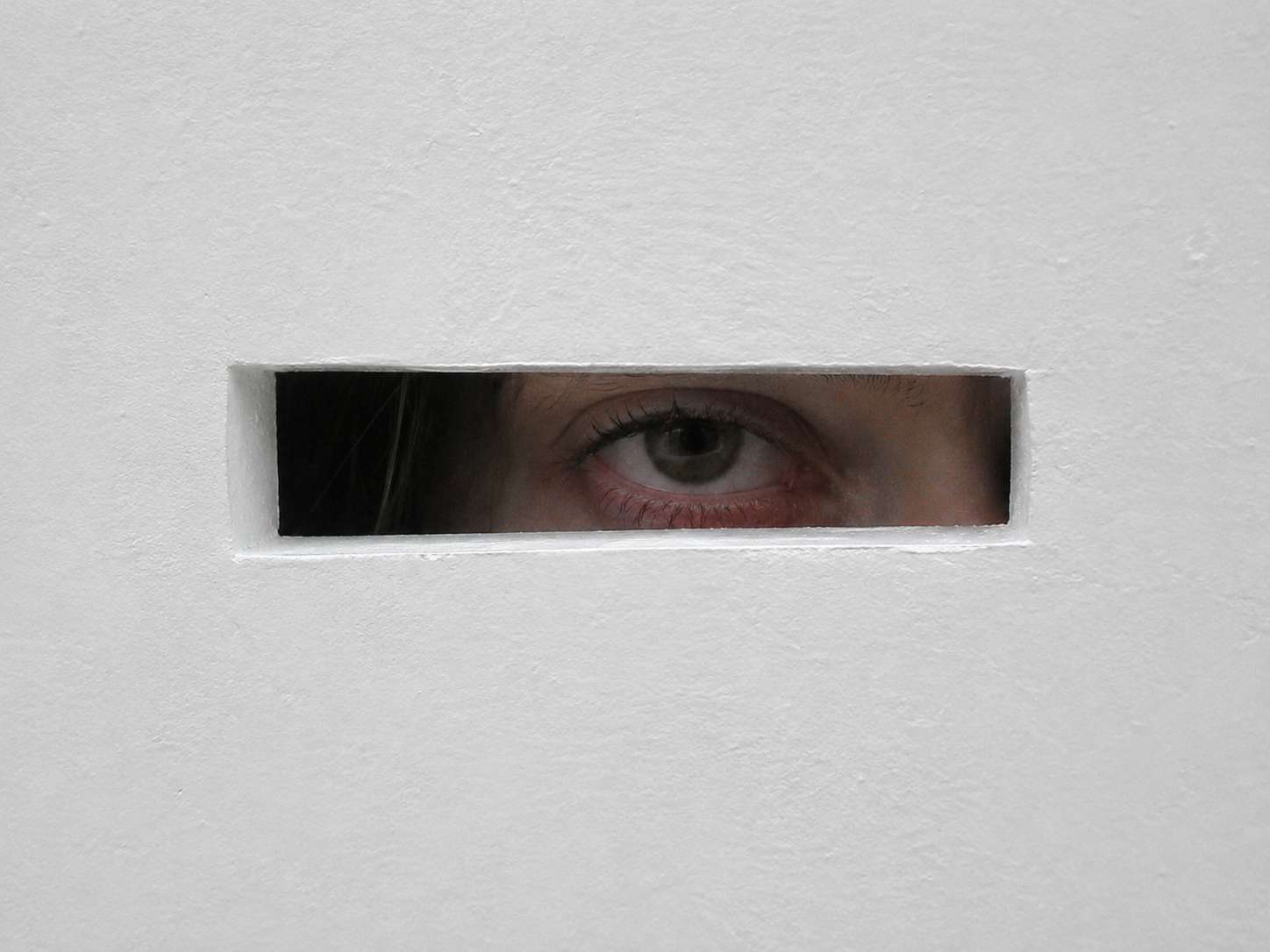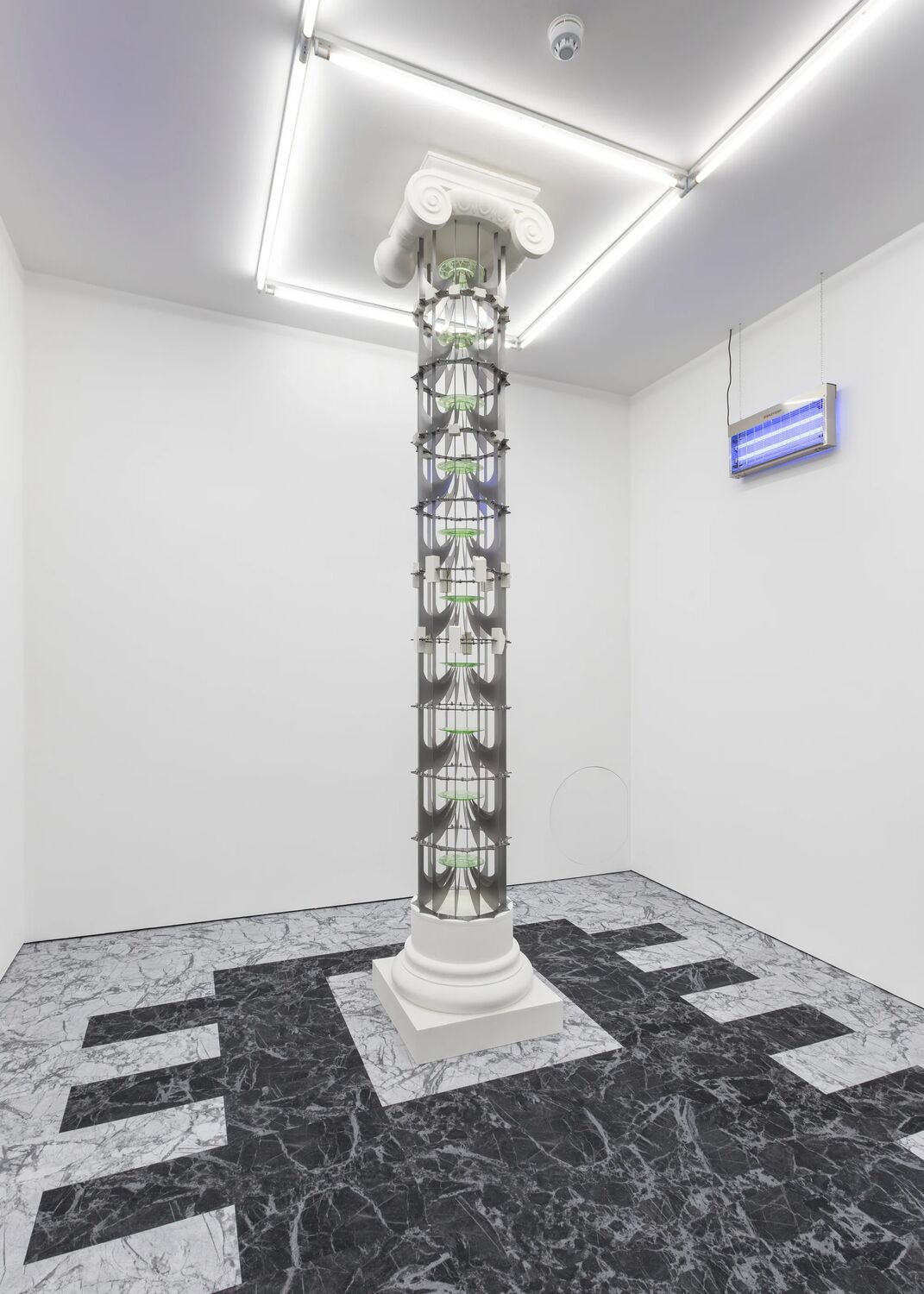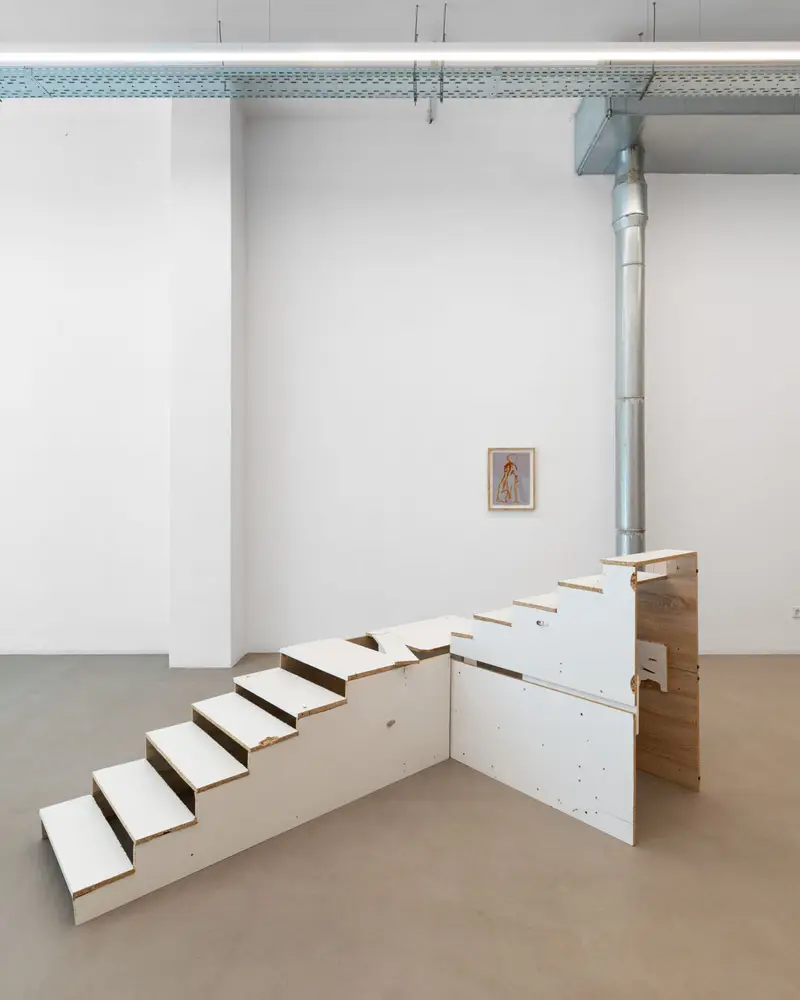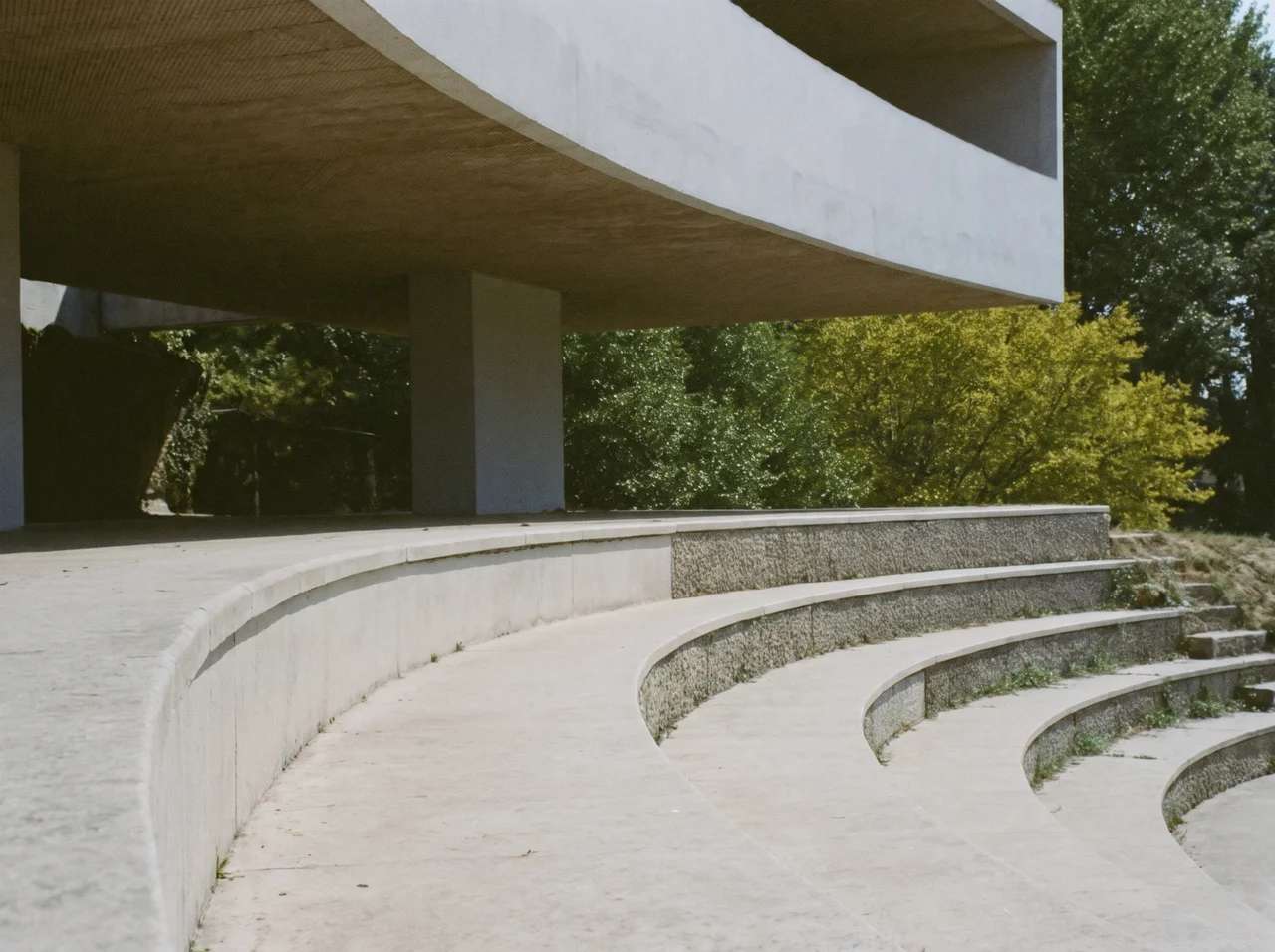
By the time the photographer arrives, the gallery has already spent several hours preparing to look unprepared. The ladder is in the office. The foam that supported a sculpture is folded against the door of a cupboard. A technician has removed a set of black marks left where the feet of the ladder slid. Someone has set the lighting to the level agreed on the previous evening, when the projector could still be heard over a conversation. The photographer stands in a corner that will be occupied by a bench when the exhibition opens. From there it is possible to see the sculpture and, beyond it, two of the paintings. The first image the public will see is made during a short interval in which the room has been arranged for a visitor with a tripod.
That interval helps explain the curious tense of an installation view. It appears on an announcement ahead of the opening, where it offers a glimpse of something readers can soon visit. It stays on the gallery website when the works have gone back into their crates. Years later someone consults it to establish which painting was hung next to which. The same picture moves through these uses with the date of the exhibition attached. Its authority grows as the room itself becomes harder to consult. What began as a photograph taken on a particular afternoon can become the only available basis for making a claim about a show that lasted six weeks.
The possibility of generating a convincing installation view in advance puts pressure on this arrangement. An image can reproduce the signs of a photograph commissioned by a gallery before anyone has committed to a room. Viewed alone, the image may support judgments about colour, placement and the apparent size of a work. Set beside an opening date, a gallery address and a credit line, it picks up a different kind of authority. A file made to settle a question about a future display is now liable to be cited as an account of the display itself. Much of that change takes place in the few lines that accompany the photograph.
Mario Carpo opens a question about what counts as a copy when a system can produce a plausible instance of a familiar kind without a single original to place beside it. Exhibition photography gives that question an unusually concrete answer. A generated image can repeat a way of standing in a room, of leaving space around an object and of judging which architectural details belong in the picture. Those conventions were established through thousands of situations in which somebody had to make the room visible from a particular position. A model can produce another instance of the convention with no corresponding position in a building. The apparent novelty of the particular room is part of its plausibility. We recognise the sort of picture immediately and have little reason to expect to recognise the room.
Brian O’Doherty’s essays on the white cube help explain what gets repeated. The gallery’s apparent neutrality requires decisions about what may enter, what may remain visible and how the spectator is expected to behave. The installation photograph inherits those conditions and makes a few more decisions of its own. Walls are corrected towards vertical. The doorway from which the view was taken may sit just outside the crop. Objects in the corners may be moved into storage for the duration of the shoot. A concrete floor acquires just enough reflection to pick out an object’s shape. The better these adjustments work, the easier it is to take their combined effect for a quality of the exhibition itself.
The look is portable across venues. A well-lit photograph of a municipal gallery and a photograph of a small project space can be prepared by different people working under different conditions, yet both can make the distance between works read with the same studied ease. The visual agreement has helped photographs travel between venues, journals and archives. It also means that competence in the genre can be borrowed. A room in which nobody has yet found a way to light a sculpture can resemble a room with a lighting crew, a scheduled shoot and an established practice of commissioning photographs. What is being reproduced is partly the appearance that this work has been done.
A great deal of this labour is reasonable. An electrical outlet along a wall can pull the eye towards the edge of an image. The photographer who moves half a metre to bring the far work into view may show a relation that the visitor would have discovered by walking across the room. The result is selective, and its selection has consequences for what we can infer. A wide view is good evidence that several works stood together when it was taken. It can give a thoroughly misleading account of the distance between them. It has even less to say about the work that sounded from behind a partition. The conventions help us use the picture, provided we keep track of the claims those conventions can carry.
Consider Louise Lawler’s 1984 photograph of a Pollock with a decorative tureen in the Connecticut home of the collectors Burton and Emily Tremaine. The painting is already part of a domestic composition, and Lawler’s framing brings the two objects into a relationship that an isolated reproduction of the canvas would never supply. The title credits the Tremaines with the arrangement. That detail assigns a role to the people whose decisions the photograph makes visible. The room became part of the picture’s subject, down to the narrow band of wall and the few inches separating the objects. An art image can carry information about ownership, habits of display and the proximity of things whose usual paths through an institution would keep them apart.
The same example shows what a technically convincing reconstruction could leave unsettled. Imagine a generated room with a correct reproduction of the Pollock, a porcelain vessel of the right manufacture and walls matched to a photograph of the house. Even if a later source confirmed the likeness of every object, the evidence for their arrangement would still lie with the records used to make the image. Lawler’s photograph offers a basis for asking how the objects occupied the room together at the time of exposure. A reconstruction can offer a basis for asking whether an account of that arrangement makes spatial sense. The questions sound close until someone tries to answer one with the evidence appropriate to the other.
Odd details can help us judge what a view establishes. A rectangle of sunlight against a temporary partition can indicate where a room opened onto the street. A doorstop can show that a door designed to remain open was held in place. A crooked cable may explain how an apparently freestanding sculpture was powered. All three details can also be put into a synthetic view. Their documentary significance depends on what they can be connected to beyond the picture. Once there is a source for the geography of the room, the sunlight may help orient another frame. Without that connection, the sunlight supplies an impression of location that can be remarkably persuasive on its own.
A reconstruction can make its own grounds of authority available. Hal Foster describes how Alexander Kluge asked Thomas Demand to recover the memory of his former Munich studio. Demand used material from television interviews recorded in the room to construct the model he photographed for Repository (2018). The earlier footage had been made to show people talking. Desks, shelves and equipment survived in the frame through their proximity to the people in front of the camera. Demand made those surroundings the subject. The photograph is a finished object with a date of its own, and the footage remains available in the account of how a room that had been abandoned was made visible again.
There is a small problem of perspective inside that story. Think of the parts of an interview room least likely to survive in its footage. The wall behind the camera is a first candidate. The space beneath a table may scarcely appear. Whoever reconstructs such a room has to decide how much can be inferred from the edges of a shot and what to do with the parts that cannot be inferred at all. Recognising the photograph as a reconstruction lets the viewer reflect on those decisions. Every surface may be equally clear in the finished picture, even though the decisions that produced the surfaces rested on very different amounts of information.
This is a familiar condition in exhibition history. An installation is remembered from a packet of photographs, a floor plan found in a folder and incompatible accounts of what was visible from the street. A visual reconstruction can bring those sources into a common space. It might expose a mistake in a proposed layout when two works cannot occupy the stated positions without blocking an entrance. It can also give a definitive appearance to an area about which the sources are silent. A useful reconstruction credits the record it draws from and has room to acknowledge a part of the exhibition that remains unresolved. The work of piecing together a view becomes part of what the archive holds.
The Museum of Modern Art’s exhibition history gives a sense of how records can do this work together. A page may contain installation photographs, a checklist, a press release and a catalogue. What one document establishes can qualify a reading of another. A checklist can help identify a work partly visible in a wide photograph. A dated caption can distinguish an installed arrangement from a plan. A catalogue can indicate that a work belonged to the exhibition even if it never appears in the surviving installation photographs. The records may leave a question open or even disagree with one another. Keeping them visible gives researchers a way to pursue the disagreement.
Many small galleries can assemble a comparable set only in fragments. The plan may exist in a message thread. The photographer may be able to supply three images and a precise date. An artist may remember why a piece moved halfway through the exhibition. These are modest records, and the next person to consult them may value the details the original publisher hardly considered worth preserving. A single polished view can overwhelm this less coherent material when it appears on the page with the date and location. Its ease of use determines which version of the room gets passed forward. The publication has already done a little historical editing by the time the search begins.
The pre-installation image introduces a further complication. In the ordinary course of planning, a room passes through studies, measurements and proposals. A picture made to test a project can now circulate in the visual register of a completed show while the outline of that project is still open. Think of a work whose surface requires the lights to stay low, or an object that ought to pull a visitor towards an awkward corner. Once a promising image of the room is in the press folder, raising the lights or moving the object can become a way to bring the room back into line with a picture that was meant to help decide what the room should be.
The sequence matters because an exhibition is one of the places where a work can still change through contact with other things. A painting may read as self-contained in a studio photograph and begin to behave like part of a pair when it is hung across from another. An object that feels slight on its own can keep drawing the eye simply because it sits behind a column and appears late in a visitor’s route. These are discoveries made through placement, duration and movement. A proposal image is useful during that work when there is still an opportunity to test what it suggests. As soon as the promised image becomes a fixture, the exhibition can lose some of its practical room for discovery.
This is especially clear when installation work produces revisions nobody would have requested in a prompt. A fabric work falls more heavily under its own weight than the small model suggested. The gap beneath another work grows wide enough to see the wall through it, and a piece intended to sit alone starts to register the colour of whatever stands behind it. The person adjusting the fitting may notice the change before anyone who saw the render. In a record assembled later, a photograph of that adjustment could explain why the visible result differs from the initial plan. It could also establish that the artist used the installation itself to make a last formal decision. The preliminary image becomes much more interesting once there is a way to see what the room did to it.
Some exhibitions are conceived for the screen, and a synthetic view can be the work’s means of public presentation. A project might use the recognisable route through a gallery, with corners and views into successive rooms, as a composition inside a digital space. In that case the image can be direct evidence of a work that took place on the screen, complete with its own date and circumstances of access. A later document can show when the project went online, how it appeared and how visitors moved through it. The appropriate record follows where the work was available. A picture of a room can participate in a work without the public having had access to a room with that address.
Some reports of an exhibition will inevitably depend on seeing it at second hand. A reader overseas or a writer working after the closing date may know the work more closely through a handful of images than someone who walked through quickly one Saturday. That makes the difference between seeing the exhibition and being able to study a document of it worth keeping. A document can be returned to, enlarged and compared against other records. Giving it a precise account of its relation to the exhibition makes those activities possible. The point of identifying that relation is to allow the distant reader to make a better judgment from where they are.
These cases make the language around images an editorial matter. A credit that says who made a view supplies one kind of information. A line that says when the image was made, what was in front of a camera or what was reconstructed from earlier material supplies another. A mock-up sent three weeks before an opening can say that it shows a proposed arrangement. A photograph made after a wall was taken down can say that it shows the last week of a changing display. Both lines give the next reader a way to ask a more precise question than whether the picture looks credible. They also make it possible for later accounts of the show to differ for reasons a researcher can trace.
Hito Steyerl’s account of the poor image drew attention to what copies acquire and lose in circulation. A screening copy can reach viewers who would otherwise never encounter a film. A photograph detached from its exhibition page can become a reference for another artist, find an attentive audience and turn up in unexpected contexts. The practical problem for a generated installation view is that a file can travel with its finish intact while shedding a short explanation of how it was made. A downloaded image is likely to retain the persuasive shape of its light and its perspective. The line that identified it as a study may have been visible only in the email or layout it left behind.
Signed provenance can help associate a file with a sequence of operations, where the information was recorded and survives. The C2PA’s own explanation distinguishes the history of an asset from what it can establish about the truth of a scene. A properly documented camera capture could show a paper model. A normally exposed image could show an arrangement temporarily staged to make a picture after the exhibition closed. An account of where the file came from still needs to meet an account of what the image was commissioned to do and what took place at the location it names. These are obligations that publishers share with photographers, artists and institutions. A technically competent file cannot discharge them on its own.
The problem becomes more concrete at the point of reuse. A magazine receives a group of numbered images, all looking ready for publication, with the gallery’s announcement as a separate document. One view was generated for the announcement. A second was made on installation day. A third shows a change the artist made after the first weekend. All three could legitimately contribute to an account of the exhibition. There are materially different consequences if a reader is in a position to tell which is which, particularly if the magazine is read long after the original announcement is gone. Someone who describes the show in a later essay may end up attributing an arrangement to the artist that the artist had actually abandoned before the doors opened.
Preserving an image’s role can also make it more rewarding to look at. A preliminary view might show that an arrangement once depended on a symmetry subsequently broken. A photograph of a temporary installation can show a workaround that became part of the public experience. Demand’s work gains a layer through the knowledge of what was rebuilt, just as Lawler’s gains one through the identification of who arranged the things she photographed. In each case a few particulars of production return an act of placement to the picture. The increasingly persuasive look of an anonymous installation view makes those particulars easy to overlook and unusually valuable to recover.
Something similar happens in the interval with which we began. The photographer can stand where the bench will go because, for half an hour, there is no bench. Six weeks later a reader might wonder why every photograph gives the impression of a room in which standing still came naturally. One ordinary production note could answer part of the question. A second photograph taken after the bench was put in place might reveal who could sit and which works could be seen together from that seat. The exhibition was capable of both views. To remember the room well is to keep a place for the work of putting the bench back.
References
- Mario Carpo, AI for Modernists, Artforum, September 2026
- Brian O’Doherty, Inside the White Cube
- Louise Lawler, Pollock and Tureen, Arranged by Mr. and Mrs. Burton Tremaine, Connecticut, 1984
- Hal Foster on Alexander Kluge and Thomas Demand’s Repository, excerpt reprinted by Princeton University
- The Museum of Modern Art, About our exhibition history
- Hito Steyerl, In Defense of the Poor Image, e-flux journal, 2009
- C2PA, Content Credentials Explainer