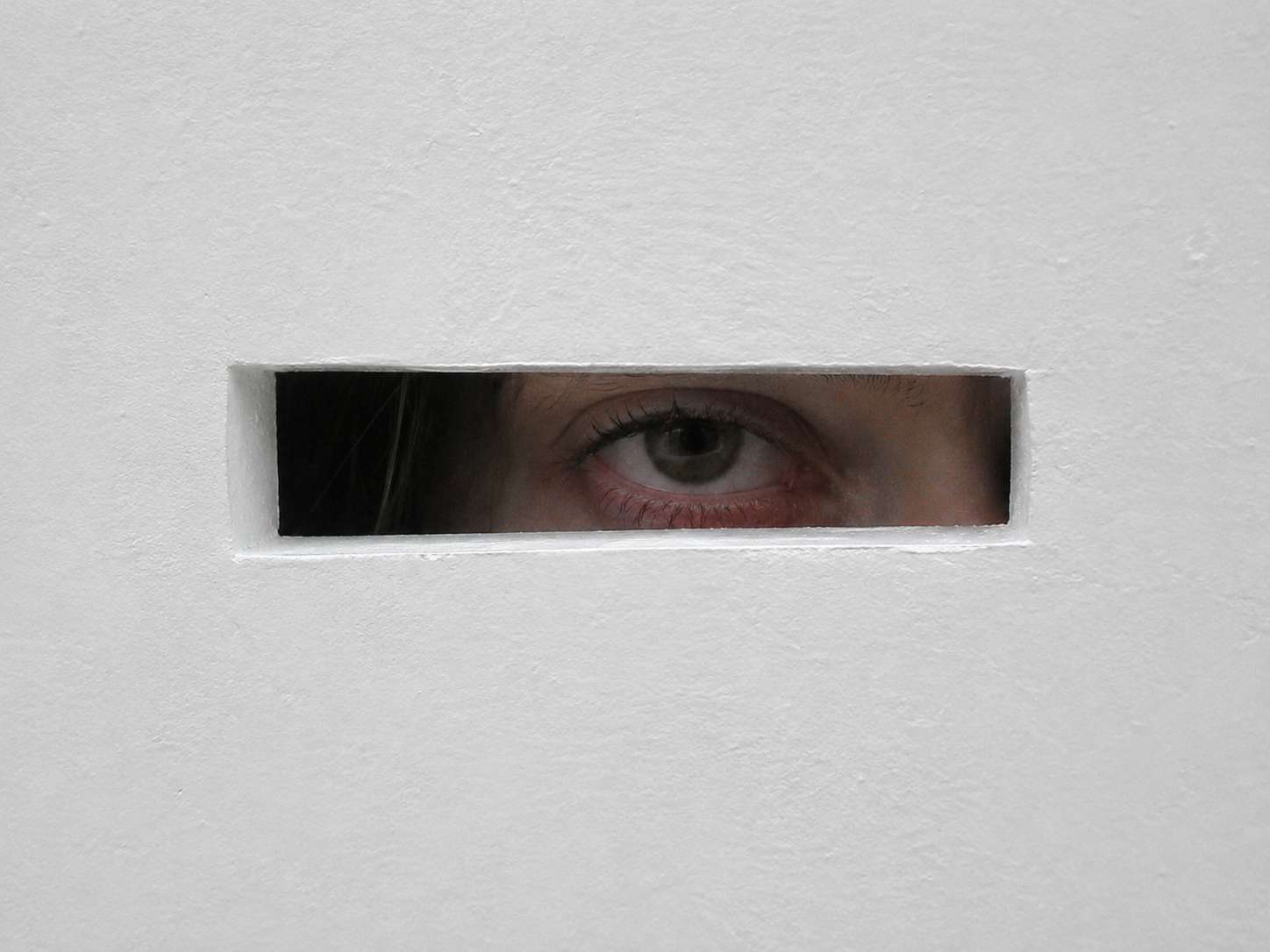
At the Philadelphia Museum of Art, a visitor first meets a closed door. It is old, roughly fitted, and pierced by two small holes. Looking through them is not optional etiquette but the only way to see Marcel Duchamp’s Étant donnés: 1° la chute d’eau, 2° le gaz d’éclairage. Beyond the door, a recumbent nude holds a gas lamp against an artificial landscape; the waterfall moves, yet the body does not. The scene is visible to one person at a time, while everyone else waits behind a viewer whose posture—bent forward, face pressed toward the wood—becomes part of the work’s public appearance. What looks like access is organised by obstruction.
Duchamp constructed the tableau in near secrecy between 1946 and 1966, when many believed he had abandoned art for chess. The Philadelphia Museum records that he prepared an illustrated manual for dismantling and reassembling it, completed in 1966; after his death in 1968, the work was installed at the museum and unveiled in 1969. These are documentary facts. The further claim—that secrecy belongs to the work’s form rather than merely to its biography—is an interpretation, but one supported by the encounter itself. The door converts disclosure into a narrow, private act inside a major public institution. The manual, meanwhile, guaranteed a future display for an object whose present had been deliberately restricted. Concealment and exhibition were planned together.
Artistic production without an audience is therefore rarely production outside relations. More often, it is a redistribution of those relations across time. A work may refuse immediate spectatorship while depending on a later witness, an executor, an archive, or a rumour. Invisibility is not a neutral lack. It is a condition made by protocols: who may see, when they may see, what counts as evidence, and which institution is authorised to say that something occurred. The paradox begins here. To withdraw a work from public recognition can protect the activity from contemporary judgement, but the withdrawal acquires artistic legibility only when it leaves a transmissible difference—a statement, a sealed object, a set of instructions, a changed life.
This does not mean that all private making secretly seeks fame. It means that “audience” names several functions too easily collapsed into one. There is the person physically present before an object; the addressee imagined during its making; the custodian who preserves it; the reader who encounters a document; and the historical public that forms after the artist can no longer control the terms. Duchamp separated these functions with unusual precision. A few trusted people knew of the project, the manual addressed future technicians, and the finished installation manufactured a succession of solitary viewers. The public did not disappear. It was partitioned.
The distinction changes how the work’s materials read. The weathered door, bricks, twigs, painted and photographic elements, the sculpted figure, lamp and motorised waterfall do not merely simulate a scene. They build a viewing apparatus. Its realism is inseparable from the spectator’s exclusion: the body beyond the door appears exposed, yet the viewer cannot enter; the viewer looks anonymously, yet becomes conspicuous to anyone standing nearby. Scale matters because the tableau is neither a picture available at a glance nor a room one can occupy. It is a chamber withheld from the body that activates it.
Walter Benjamin’s account of the shift from cult value to exhibition value is useful at this point, but only if the opposition is not treated as a historical switch that has already been completed. In “The Work of Art in the Age of Mechanical Reproduction,” Benjamin describes how an object’s restricted existence and its capacity for display organise different kinds of value. Étant donnés folds those conditions together. Its years of secret production resemble cultic withdrawal, while its permanent museum installation makes that withdrawal endlessly exhibitable. The work does not restore an intact aura; it engineers scarcity at the point of vision. Every visitor can in principle see it, but nobody can see it collectively.
The result complicates a familiar moral language around visibility. Public exposure is often equated with democratic access, while secrecy appears elitist or evasive. Yet mass visibility can also standardise an encounter, converting the work into an image that precedes and disciplines attention. Duchamp’s door slows circulation by making the visitor perform the gap between reproduction and experience. Photographs document what lies behind it, but they cannot reproduce the social arrangement at the threshold. This is not a mystical remainder. It is a concrete difference between seeing a scene and being positioned by an apparatus.
The work’s delayed public life also reveals a risk. Once secrecy becomes known, it can be romanticised as proof of artistic purity: the master laboured unseen, indifferent to applause. That story is too smooth. Duchamp did not simply renounce reception. He designed a posthumous reception in detail and secured the work’s material future through instructions and trusted intermediaries. His absence intensified institutional responsibility. The museum did not discover a private truth untouched by circulation; it became the machine through which the secret could finally operate.
On 31 December 1986, Tehching Hsieh declared a thirteen-year plan: he would make art during that period and would not show it publicly. The work ended on 31 December 1999. The artist’s own documentation presents the initial statement, the duration and a concluding declaration; Dia Art Foundation and M+ identify the work as Tehching Hsieh 1986–1999 (Thirteen Year Plan). Those records establish the rule and its completion. They do not disclose a hidden corpus, because the plan did not culminate in the later exhibition of thirteen years’ worth of objects. What becomes public is the boundary placed around an interval of life.
This case shifts the problem from the concealed object to the unverifiable activity. Duchamp left an elaborate thing awaiting installation. Hsieh made the non-showing of whatever he made the operative condition. The audience receives a statement before the duration and a statement after it, but not the material that might ordinarily connect intention to result. The work asks whether an artistic commitment can be recognised without granting spectators the evidence by which artistic labour is normally judged.
Here invisibility is less a visual quality than an asymmetry of knowledge. Hsieh knows what he did; the public knows the rule under which he lived; neither knowledge can substitute for the other. The plan gives the interval a form, but it refuses the compensatory pleasure of disclosure. There is no final opening of the vault. Consequently, the public cannot transform patience into possession. It can only confront the fact that the work’s duration exceeded its access to it.
Hsieh’s earlier One Year Performances make this refusal more exact. Between 1978 and 1986, he carried out five year-long works structured by explicit rules: confinement in a cage; punching a time clock each hour; remaining outdoors; being tied by a rope to Linda Montano without touching; and abstaining from making, viewing, discussing or reading about art. MoMA’s records describe how photographs, timecards, statements, objects and posters document those works. Such materials do not contain the lived duration; they produce a public structure through which duration can be inferred. A missed punch, a photograph, or a signed rule is evidence because the work has first defined what counts as compliance.
The thirteen-year plan removes much of that evidentiary density. Its sparseness is not simply a shortage of documentation. It tests the contract on which conceptual and performance practices often depend: the artist proposes a rule, material traces certify adherence, and institutions stabilise the relation between them. Hsieh retains the proposal and completion while withholding the middle. Viewers must decide whether their demand for proof concerns the integrity of the work or their own expectation that artistic time become available as cultural property.
Peggy Phelan’s Unmarked: The Politics of Performance appeared in 1993, midway through Hsieh’s plan. Her influential argument links performance to disappearance and resists the assumption that documentation can preserve the event without changing it. Hsieh’s work sharpens that problem because the missing event is not a single live encounter that escaped recording. It is a thirteen-year interval constituted by a ban on public showing. Documentation here does not fail to capture the work; limited documentation is one of the work’s active constraints. The distinction matters. Romanticising disappearance can turn absence into a special effect, whereas Hsieh makes absence administrative, dated and severe.
The plan also exposes the labour concealed by the phrase “without an audience.” Maintaining a rule for thirteen years requires no applause, but it does require a relation to an imagined future in which the rule will be declared complete. The calendar is the minimal public medium. Each passing day carries the work toward a date shared by others, even when its contents remain private. Time supplies the common support that visual access has been denied.
A complication follows. If an artist can designate unshown activity as art, artistic autonomy may appear absolute: private intention becomes sufficient, and criticism loses purchase. But the structure of Hsieh’s work points in the opposite direction. The rule is intelligible because it uses public language, fixed dates and the conventional authority of a signed statement. Its autonomy depends on recognisable forms of obligation. Furthermore, subsequent museum acquisition and exhibition do not merely reward an already complete act; they shape the present conditions under which the act can be believed, studied and compared.
This institutional afterlife is neither a betrayal nor an innocent container. When a museum displays the statement, invisibility becomes visible as a historical proposition. The document can acquire aura, insurance value and wall space even though the plan challenged the equation of art with displayable output. That contradiction does not cancel the work. It shows that withdrawal has no uncontaminated exterior. Refusing immediate circulation can alter the route by which value is made, but it cannot guarantee freedom from value.
The difference between Duchamp and Hsieh is thus not secrecy versus performance. It concerns the location of the remainder. With Étant donnés, the public eventually receives a material scene whose mechanism renews the original logic of concealment. With the Thirteen Year Plan, the public receives a temporal outline whose interior remains inaccessible. The first makes us look through a barrier; the second makes the barrier the only stable object of attention.
Lee Lozano’s Dropout Piece puts greater pressure on the thesis because its withdrawal did not have a predetermined end or a carefully arranged unveiling. In notebook entries begun around 1970 and through her departure from the New York art world in 1972, Lozano treated dropping out as a work. Museo Reina Sofía describes it as the culmination of her language-based pieces and dates its consequence to 1970–72; MoMA notes that by 1971 she had deliberately abandoned her career, while Moderna Museet records her exit from the New York scene in 1972. The variation in dates is not a trivial cataloguing error. It indicates the difficulty of locating a work that migrated from written instruction into an extended social fact.
The documentation permits several firm observations. Lozano had exhibited paintings and language pieces, including a solo exhibition at the Whitney Museum of American Art in 1970–71. Her notebooks framed withdrawal as an intentional piece rather than a silent fading of opportunity. She then left the professional network in which her work had circulated. What the documents cannot settle is whether every later refusal, isolation or biographical consequence should be absorbed into the artwork. To do so would convert an uneven life into a perfectly bounded performance after the fact.
Dropout Piece reveals the ethical limit of reading invisibility as a medium. The more completely an artist withdraws, the less able she is to correct the narratives produced around that withdrawal. Curators, estates, galleries and critics then become unusually powerful. They can return the artist to visibility by exhibiting paintings and notebooks, but they can also make disappearance into a signature style: Lozano, the artist who left. The historical recovery that counters neglect may simultaneously package the refusal it claims to honour.
This is where Hsieh’s protocol and Lozano’s departure diverge. Hsieh established a start date, an end date and a public condition. Lozano’s dropout was porous. It crossed professional, economic and interpersonal registers, and its later legibility depends on papers that were not neutral reports. Handwriting, capitalisation, wordplay and revision give the notebook pages visual and rhetorical force. They are records, proposals and objects at once. To call them mere documentation understates their composition; to call them transparent evidence overstates what they can prove.
The case also complicates the idea that production without an audience preserves artistic freedom. Withdrawal can refuse demands for novelty, availability and self-promotion. It can interrupt the feedback loop through which an artist learns to repeat a recognisable product. Yet absence has material costs distributed unevenly. To remain unseen requires time, housing, income, storage, trust and often someone else’s archival labour. The rhetoric of pure autonomy can conceal those supports just as effectively as publicity conceals the work behind an image.
For this reason, “art beyond visibility” should not be treated as a heroic genre. It is better understood as a field of techniques and consequences. Secrecy can delay interpretation; a protocol can limit access; an archive can transmit an action; disappearance can frustrate institutional capture. Each operation produces a different audience rather than abolishing audience altogether. Even a work known to no one cannot enter criticism until some relation—material, linguistic or biographical—brings it within reach. The question is not whether the work existed before that moment, but what claims become possible once someone speaks for it.
The three cases produce three models of the deferred witness. Duchamp builds a future viewer into the object and makes access bodily narrow. Hsieh addresses a future public through a contract whose central activity remains withheld. Lozano leaves a discontinuous record that later publics use to reconstruct an exit they cannot directly observe. In each, visibility is an arrangement of authority. The museum visitor, the contractual witness, the notebook reader and the curator do not receive the same work because their positions determine what can count as the work.
This has consequences for contemporary circulation. Digital platforms encourage artists to release not only finished works but continuous proof of working: studio images, installation views, announcements, metrics and personal commentary. Under those conditions, refusing visibility may seem like the last defence of an undivided practice. But refusal alone cannot escape the platform’s logic. Silence can become branding; rarity can increase demand; delayed revelation can function as a campaign. The critical task is therefore not to celebrate absence but to describe its mechanism. Who maintains it? What evidence survives? Who benefits when it ends? Who is authorised to narrate what happened?
A work made without present spectators may protect experiment from immediate consensus. It may also postpone scrutiny, concentrate interpretive power or depend on resources that remain unnamed. These are not objections external to the work. They are part of its conditions of production. The most consequential examples do not offer invisibility as innocence. They make the boundary between privacy and publicness perceptible, then force the viewer to notice the labour and institutions holding that boundary in place.
Returning to the door at Philadelphia, its two holes no longer seem merely to promise a hidden image. They specify a politics of reception. One person sees; others wait; the institution preserves the mechanism; the dead artist’s instructions continue to organise living bodies. The scene beyond the door matters, but so does the queue on this side. Art without an audience is not a sealed interior. It is the decision to defer, divide or condition the witness—and the history that begins when the witness finally arrives.