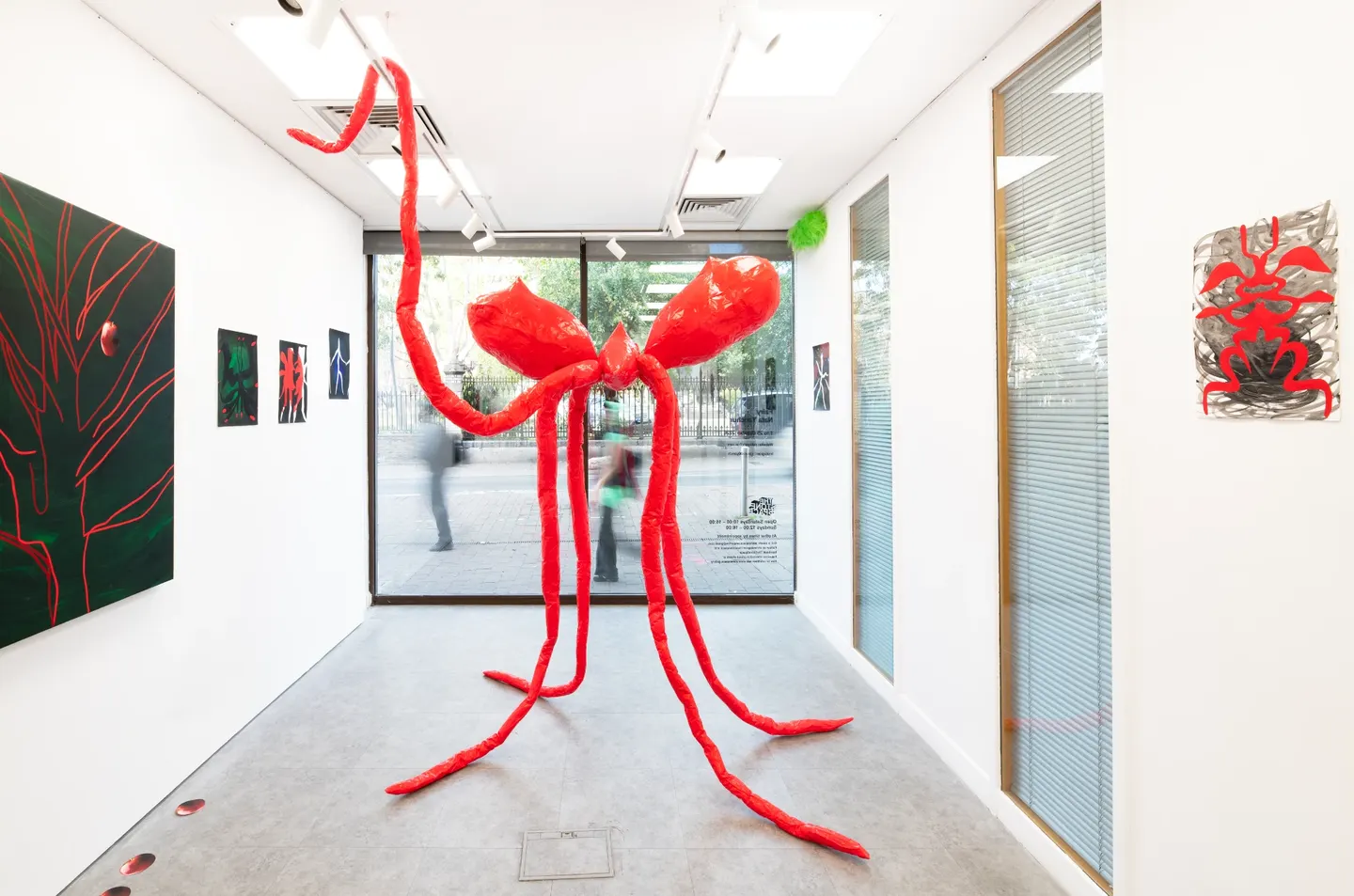
'Fairy' is an exhibition that considers the unstable boundary between fiction, glitch logic, and the collective subconscious, where reality begins to tremble and categories become uncertain. The show creates a space in which the audience does not merely observe but participates, moving between myth, technology, and sensory memory. Fantasy is approached not as an escape from reality, but as a cultural code and a language operating beyond national, visual, and linguistic systems. The exhibition becomes a speculative illusion, an installation, and a glimpse: the apparition of something moving in the bushes deep within a fairy forest at twilight, suspended between perception and imagination.
‘FAIRY’
FAIRY. Faerie. Fery. Feral. Fake. Fate. Failure. Fragment. Fever. Féerie.
The word mutates. Shimmering, unstable, ungovernable. It refuses definition the way a glitch refuses repair.
Hito Steyerl once asked:
“Who owns the cloud? Who inhabits the opacity?”
Perhaps the answer is no one or only fairies, sliding between metadata and misreadings,
contaminating the algorithmic field with impossible tenderness.
A fairy is a virus in the taxonomy of reality. A fairy is a bug disguised as beauty.
A fairy is the shimmering interface between the symbolic, the computational, and the soft flesh of feeling.
Fairy as a hyperobject. Not a being, but an atmosphere of meaning:
a sugar-coded melancholy, a wet sparkle of longing, a trembling refusal.
The word fairy contains:
*myth
*insult
*pop mythology
*resistance
*mutation
*softness as an attack
In Victorian language, fairy was already a wound and a miracle: socially unclassifiable, too queer to disappear, too symbolic to exist.
Fairy is becoming. Fairy is disobedience.
Fairy is a linguistic accident turned into a portal.
Can you be a fairy without believing in magic?
Or does the belief begin only after you lose certainty?
This is not an exhibition. This is a spell-protocol. A contamination site.
A conceptual mispronunciation. Confusion is the entry point.
Welcome, Fairy.
You’re in.